Published
Every 1980 Environmental Lien & AUL report has two jobs. We covered the second one, Activity and Use Limitations, in an earlier post. This one is about the first: environmental liens, the recorded claims that secure repayment of hazardous-waste cleanup costs. Here’s who files them, where they end up on record, and why finding them takes more than a current-owner title search.
How an environmental lien is created
The typical path runs in four steps: a release of hazardous substances is discovered on a property; a government agency investigates and cleans it up (or compels the cleanup); the responsible party doesn’t fully repay the government’s costs; and the agency records a lien against the property to secure what it’s owed.
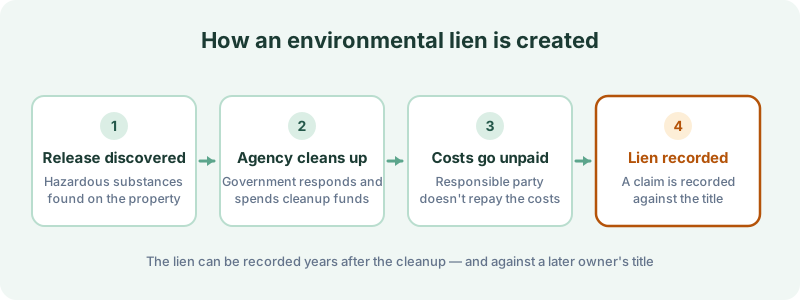
The lien is the enforcement tail of the cleanup. Because cleanups can take years, the lien may be recorded long after the activity that caused it, against an owner who had nothing to do with the original release.
Who files environmental liens
- The federal government. CERCLA, the Superfund law, gives the United States a lien on a property for unrecovered response costs the EPA spends cleaning it up.
- State environmental agencies. Most states have their own environmental lien statutes, and state liens are far more common in practice than federal ones. A handful of states even give their liens “superlien” priority ahead of previously recorded mortgages.
- Local agencies. In some places, county or municipal health and environmental departments record liens for cleanup and abatement costs.
Where environmental liens are recorded (and why they get missed)
Most environmental liens land in the county land records, indexed against the property or its owner like any other recorded instrument. But in some jurisdictions, environmental liens are filed with the clerk of the court in judicial records instead of, or in addition to, the land records.
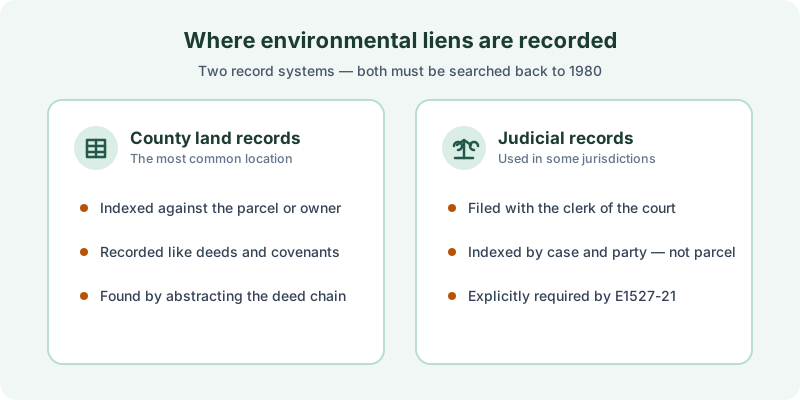
That split is exactly why ASTM E1527-21 calls out judicial records explicitly, and it’s where searches most often fall short: court filing systems are organized around cases and parties, not parcels, and older filings may only be reachable through local indexes. We maintain a complete list of state-specific local and judicial records resources for precisely this reason.
An environmental lien follows the property
Like an AUL, an environmental lien runs with the land. It doesn’t dissolve at closing. A buyer who misses one inherits a recorded claim that must be paid or negotiated with the agency before the title is clean.
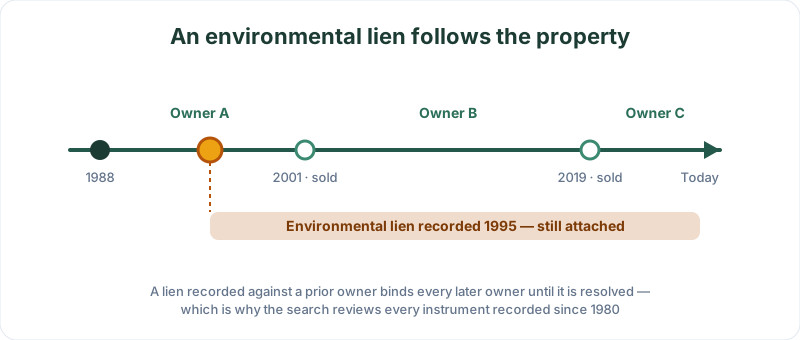
That’s the practical case for the 1980 look-back: a lien recorded decades ago against a prior owner is still binding today, and only a search that abstracts the full chain of recorded instruments will surface it.
What ASTM E1527-21 requires
The Phase I ESA standard requires land title records to be reviewed for environmental liens and AULs recorded between 1980 and the present, with judicial records reviewed for the same period in jurisdictions that file liens there. The full set of 2021 changes is covered in our comprehensive ASTM E1527-21 guide.
How a 1980 Environmental Lien & AUL search finds them
Our 1980 Environmental Lien & AUL report is researched by certified title abstractors who reconstruct the deed chain to 1980 and review every recorded instrument in it, land records and judicial records alike. The report summarizes any environmental liens and encumbrances found, along with AULs, the legal description, current owner identification, and current deed copies.
Reports are $425, delivered by email in 3–5 business days. You can order online in a few minutes, or browse our FAQ if you still have questions.
Get an E1527-21 compliant lien & AUL report
Our 1980 Environmental Lien & AUL reports are researched by certified title abstractors, cover judicial records, and are guaranteed accurate. Delivered in 3–5 business days.
or call 877-848-5337