
Published
A lease is not a purchase, and that difference has persuaded a lot of tenants that environmental due diligence is the landlord’s problem. It is not, or at least not entirely. A company that takes space at a site with an industrial past can pick up real exposure, and the federal protections written for tenants come with conditions attached. One of those conditions is the same recorded-document search a buyer performs, and it sits on the user’s side of the ledger rather than the environmental professional’s.
Why a tenant carries any risk at all
CERCLA assigns liability to owners and operators of a facility. A business running its operations on leased ground can fall inside the operator definition depending on what it actually does there and how much control it holds. That question has been litigated, and the answers have not been uniform, which is exactly why it deserves attention instead of an assumption that a lease works as a shield.
Three practical exposures show up repeatedly:
- Operator status. What you do on the site can matter more than the label on the document you signed.
- Recorded use restrictions. An Activity and Use Limitation can prohibit the very use you leased the space for, and it binds the land rather than the person who signed it.
- Contractual duties. Commercial leases frequently assign compliance and remediation obligations to the tenant, whatever the statute would say on its own.
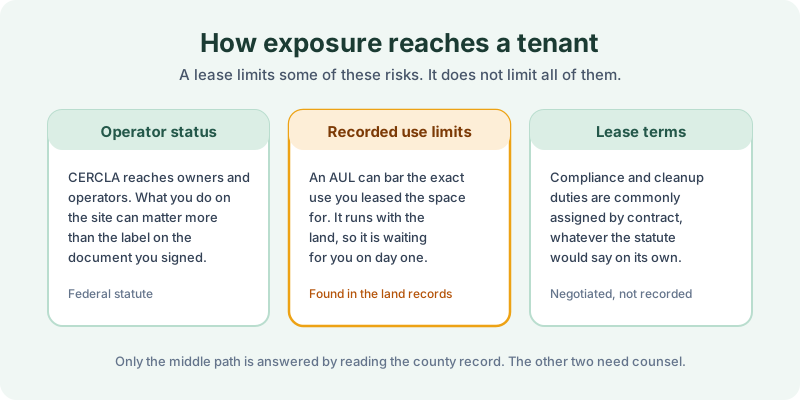
Only the middle item is answered by reading the county record. That is not a small share of the problem, though, because a recorded restriction is the exposure most likely to make the space unusable for its intended purpose.
What the BUILD Act did for tenants
For years, tenants hoping for bona fide prospective purchaser treatment leaned on EPA enforcement discretion rather than statutory text. The 2018 BUILD Act changed that by amending CERCLA to give leasehold interests their own path to BFPP status. Broadly, there are two routes.
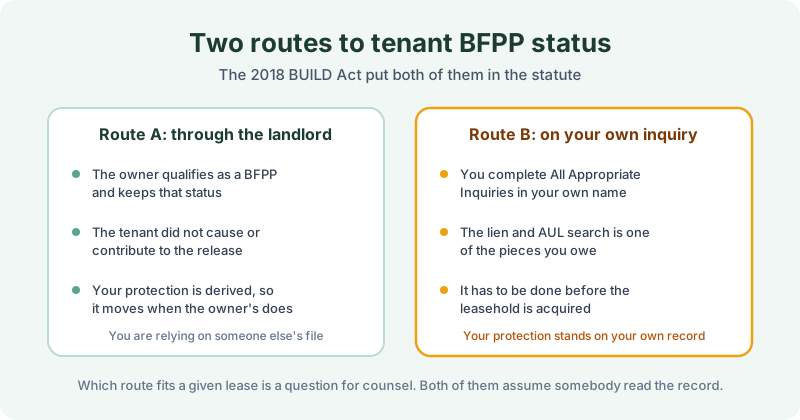
The first route runs through the landlord: where the owner qualifies as a BFPP and keeps that status, a tenant that did not cause or contribute to the release can derive protection from it. The weakness is structural. Your position depends on a file you do not control, and it can move if the owner’s status does.
The second route is your own. A tenant that completes All Appropriate Inquiries in its own name, before acquiring the leasehold, stands on its own record. The environmental lien and AUL search is one of the required pieces, assigned by 40 CFR 312.25 to the party seeking the protection. How either route applies to a specific lease is a legal question for your counsel, not something a report can decide.
What the search covers on a leasehold
Here is the part that surprises tenants: almost nothing about the search changes. Environmental liens, covenants, and use limitations attach to the parcel, so the research runs against the land and its fee ownership chain from 1980 forward, exactly as it would for a purchase.
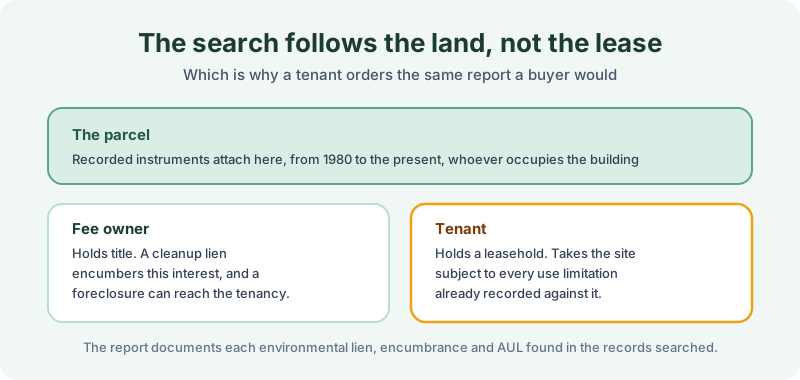
A tenant reading that report learns two distinct things. Use limitations tell you whether your operations are permitted on the site at all, which is a business question before it is a legal one. Cleanup liens tell you something about the landlord’s position, since a lien encumbering the fee can end in a foreclosure that reaches your tenancy. Neither shows up in a lease abstract, and neither is reliably disclosed.
Keep the limits in view. A records search documents what has been recorded and indexed in the offices searched; it is not an inventory of site conditions, and an empty result is not proof that a property is unrestricted. Recording practice also varies from county to county. The condition of the site itself, and any REC or CREC determination, belongs to your environmental professional.
Timing: signing is your closing
For a buyer, the deadline is the acquisition date. For a tenant relying on its own inquiry, the equivalent deadline is the date the leasehold is acquired, so the research has to be finished while the lease is still a draft. Long build-to-suit negotiations create the same staleness problem purchases do, and the same shelf-life rules apply to the components once they are complete. If a signing date slips by months, plan on refreshing the search rather than assuming it carries.
Our 1980 Environmental Lien & AUL report is researched by certified title abstractors who review land title and judicial records from 1980 to the present and document every environmental lien, encumbrance, and AUL found, with the recorded instruments attached. It is $425, delivered by email in 3–5 business days, which fits comfortably inside a lease negotiation. You can order online in a few minutes, see a sample report first, or read what to do when a search comes back with a hit.
Get an E1527-21 compliant lien & AUL report
Our 1980 Environmental Lien & AUL reports are researched by certified title abstractors, cover judicial records, and are guaranteed accurate. Delivered in 3–5 business days.
or call 877-848-5337