Published
Coal ash is one of the largest waste streams in the country and for most of its history it was not treated as waste at all. Power stations sluiced it into ponds, stacked it in landfills, and gave it away to anyone who wanted cheap fill. The federal rule governing coal combustion residuals arrived in 2015, which means roughly a century of handling happened before anyone was required to write much down. That gap shapes what a records search can and cannot find, in the same way described in how an environmental lien and AUL search is performed.
What the site itself holds
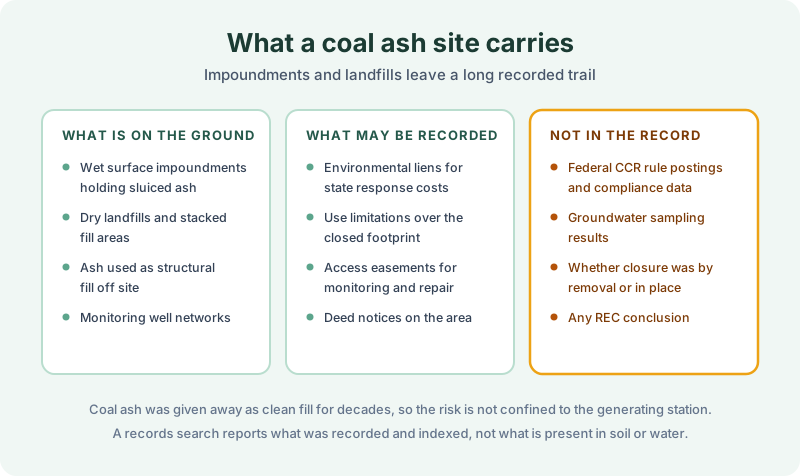
Two storage forms dominate. Wet surface impoundments are ponds holding ash sluiced in with water, often unlined and often built decades ago against a river. Dry landfills hold ash placed and compacted, sometimes with a liner and sometimes not.
The constituents of concern are metals, and the pathway that matters most is groundwater. Arsenic, boron, lithium, selenium, and sulfate turn up in monitoring wells around these sites with some regularity, which is why the closure documents for one of these facilities are worth reading in full rather than in summary.
Structural stability is the other consideration on wet impoundments. A containment failure is a surface water event rather than a slow groundwater one, and the response costs that follow are exactly the kind that produce a recorded lien. Several states tightened their impoundment rules after high profile failures, and closure obligations were rewritten as a result.
What can reach the land record
Three kinds of instrument. State environmental liens where public money has been spent on response costs, filed and indexed like any other lien. Activity and use limitations restricting what may happen over the closed footprint, almost always including a groundwater prohibition, which is the subject of groundwater use restrictions in the land record. And access easements granting an operator or an agency the right to enter and maintain monitoring wells.
What does not reach the record is most of the substance. Federal compliance postings, sampling results, the closure decision itself, and whether closure was by removal or in place are all agency and operator material. A parcel can be clean in the county index and carry a closed impoundment at the back of it. That is not a failing of the search, it is the boundary of what recording captures, and a report that implied otherwise would be the more dangerous document.
The fill that travelled
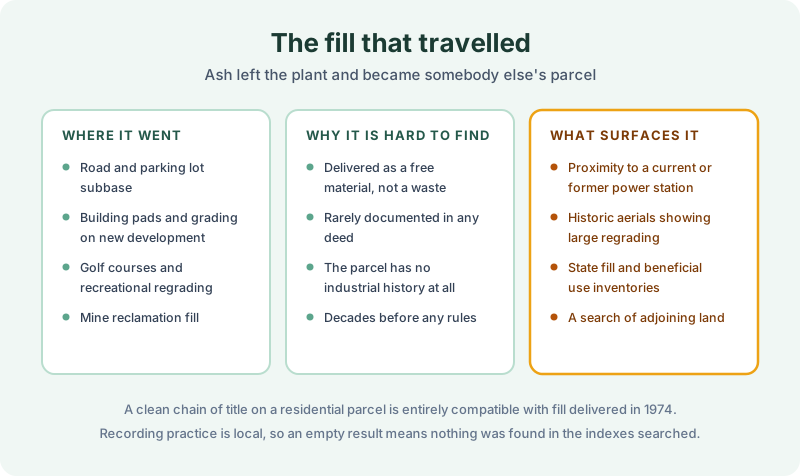
This is the part that catches people out, and it is the reason coal ash is not only a power station problem. For decades ash was supplied as free structural fill. It went under roads and parking lots, into building pads, onto golf courses, into agricultural regrading and mine reclamation.
The receiving parcel has no industrial history. Its chain of title is unremarkable, nobody recorded anything about the material, and the transaction was a favor rather than a waste disposal event. A clean chain on a residential lot is entirely compatible with several thousand tons of ash placed there in 1974.
What surfaces it is context rather than the deed. Proximity to a current or former generating station, historic aerials showing large-scale regrading, state beneficial use inventories, and a records search that covers adjoining parcels rather than only the one being bought, which is the argument made in chain of title work in a Phase I.
Scoping the work
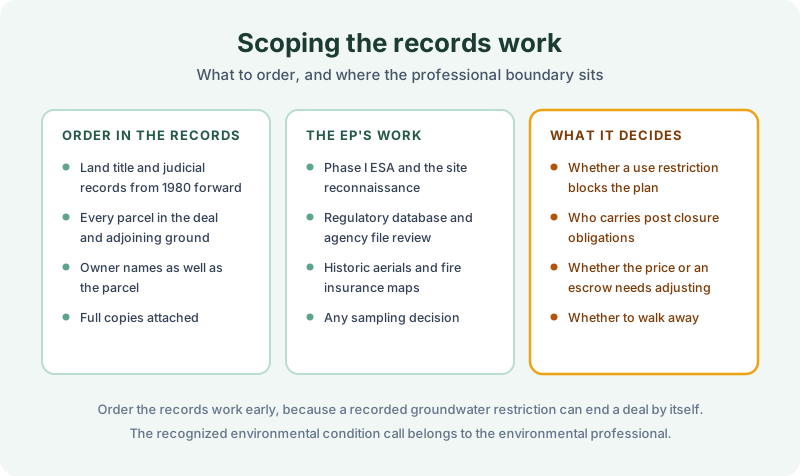
Order the records work at the front of the calendar. Land title and judicial records from 1980 forward, every parcel in the transaction plus adjoining ground, owner names as well as the parcel, and instruments attached in full rather than summarized.
Run in parallel with the environmental professional rather than instead of them. The Phase I, the database review, the agency file request, the historic aerials, and any sampling decision are theirs, and the user responsibilities the buyer owes are separate obligations a consultant cannot discharge on their behalf.
A recorded groundwater restriction can end a deal by itself, particularly where the plan involves a private well or an irrigated use, which is exactly why it is worth finding in week one rather than in week six. Recording practice is local, and an empty result means nothing was found in the indexes searched rather than that nothing exists.
The 1980 Environmental Lien & AUL report is where that records work gets done. Certified title abstractors review land title and judicial records from 1980 to the present and document every environmental lien, encumbrance, and AUL found, with the recorded instruments attached. It’s $425, delivered by email in 3–5 business days. Order online, or read what an environmental lien means once one turns up first.
Get an E1527-21 compliant lien & AUL report
Our 1980 Environmental Lien & AUL reports are researched by certified title abstractors, cover judicial records, and are guaranteed accurate. Delivered in 3–5 business days.
or call 877-848-5337