
Published
A pesticide formulation plant does not manufacture active ingredients. It receives them as concentrates, blends and dilutes them to a saleable strength, and packages the result. That sounds mild next to primary manufacturing, and the site risk is frequently anything but, because the whole operation concentrates handling of the same compounds into one yard, year after year, with rinse water as a constant byproduct. The records side of the work needs scoping deliberately rather than ordering as a standard search, in the same way a former agricultural chemical dealer site does.
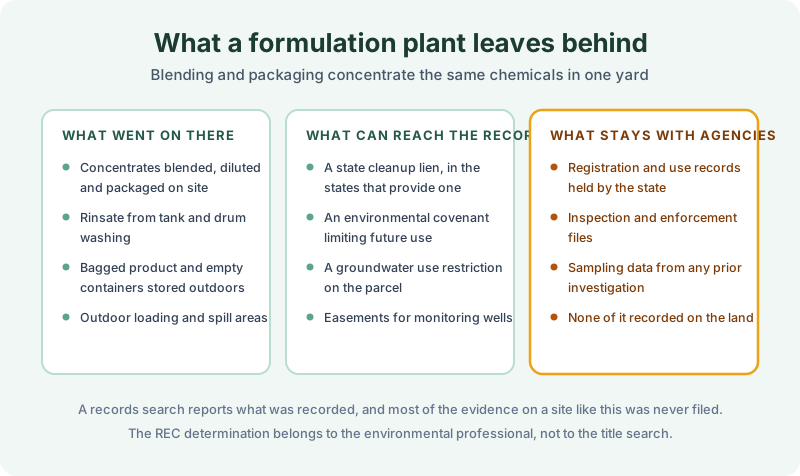
What went on there
Four activities account for most of what a consultant will care about.
- Blending and filling. Concentrates are mixed and drawn down to product strength, then filled into containers. Small losses at the filling head are routine and cumulative.
- Container and tank rinsing. Rinsate is the defining waste stream of a formulation site. Where it was collected and reused it is manageable, and where it went to a floor drain it is a problem that is now somewhere underground.
- Outdoor storage. Bagged product, drums and totes stored on unpaved ground, with weathering and occasional breakage.
- Loading and unloading. Repeated small spills in a fixed location over decades, which is how a loading apron becomes the most impacted part of a site.
Older sites also handled compounds that are no longer registered. Organochlorines, arsenical herbicides and mercury based seed treatments all passed through formulation plants, and they persist in soil far longer than the businesses that used them.
Where the residue tends to sit
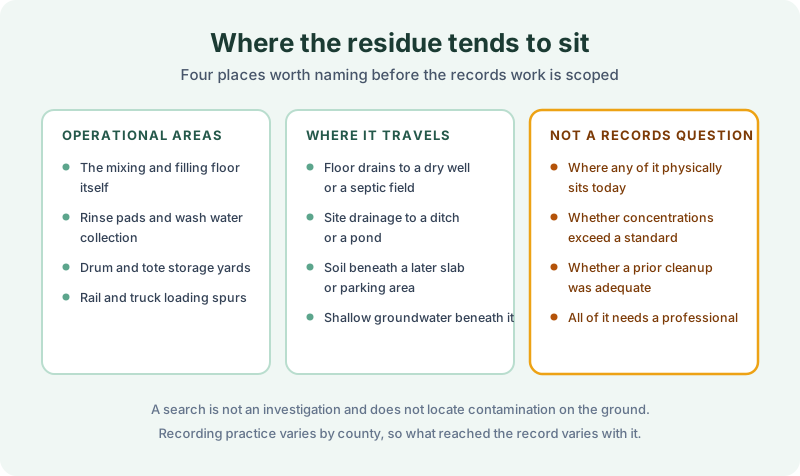
The operational areas are the obvious candidates, and the drainage pathways are the ones that get missed. A floor drain discharging to a dry well or a septic field moves the problem off the building footprint and out of sight. Site drainage to a ditch or a retention pond does the same thing across a wider area. Where the site was later redeveloped, the impacted soil frequently sits beneath a slab or a parking lot poured by somebody who had no idea what was under it.
None of that is a records question. A search does not locate contamination, does not sample anything, and does not tell you whether a concentration exceeds a standard. It tells you what was recorded, which is a narrower and genuinely useful thing.
What can reach the land record
The honest answer is not much, and knowing the short list is what keeps a search proportionate.
- A state environmental lien, in the states whose statutes provide for one and where an agency actually filed it.
- An environmental covenant or activity and use limitation, restricting future use or requiring a cap to stay intact. In the states that adopted UECA these are recorded instruments and a search will find them.
- A groundwater use restriction, barring wells on the parcel.
- An access easement granted so that monitoring wells can be reached and sampled.
That is close to the whole universe. What will not be there is the registration file, the inspection history, the enforcement correspondence and the sampling data, because none of those are recorded against land. They sit with the state agency and they are obtained by request rather than by search.
Scoping the work
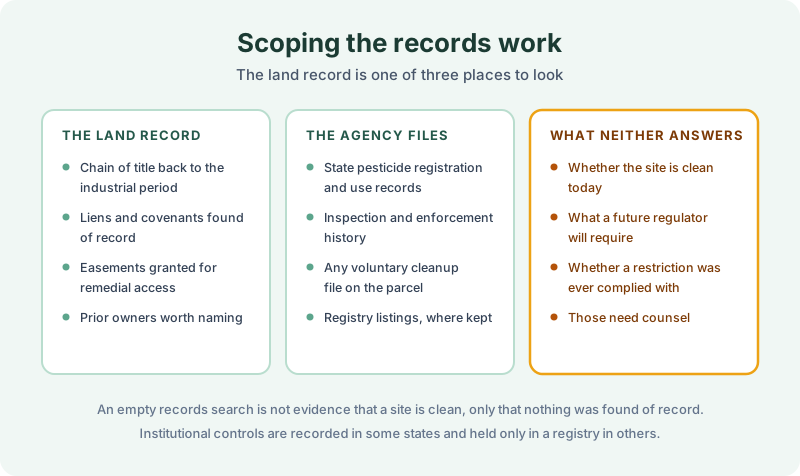
Run the chain back through the industrial period rather than for a fixed term, because the operator you need to name may have left in 1971. Take the liens, covenants and easements found of record. Then use the prior owner names the chain produced as the input to the agency requests, which is the step people skip and the one that makes the file review productive.
An empty result is worth reading carefully here. It means nothing was found of record in the offices searched, over the term searched. It is not evidence that the site is clean, and on a formulation site the absence of a recorded instrument is closer to the expected outcome than to a reassuring one. The identification of a REC, CREC or HREC belongs to the environmental professional, and a records search is one input to that judgment rather than a substitute for it.
The 1980 Environmental Lien & AUL report is built for exactly this input. Our certified title abstractors review land title and judicial records from 1980 to the present and document every environmental lien, encumbrance, and AUL found, with the recorded instruments attached. It’s $425, delivered by email in 3–5 business days. Order online, or see how the search is performed if you want the method before the order.
Get an E1527-21 compliant lien & AUL report
Our 1980 Environmental Lien & AUL reports are researched by certified title abstractors, cover judicial records, and are guaranteed accurate. Delivered in 3–5 business days.
or call 877-848-5337