Published
Most modern cleanups don’t end with every molecule removed. They end with a decision: the remaining contamination is safe if the property is used a certain way, and unsafe if it isn’t. That “if” has to bind not just the owner who agreed to it, but every owner after, for as long as the contamination stays. The instrument that carries that promise through the land records is the environmental covenant, and it’s one of the most consequential documents an environmental lien and AUL search can surface.
What an environmental covenant is
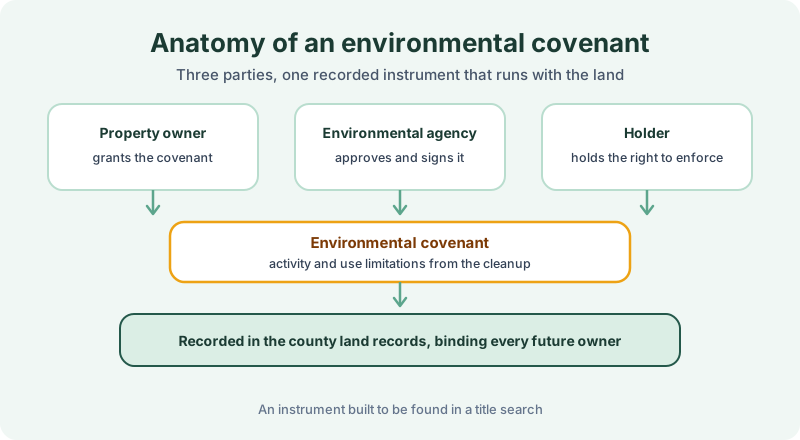
An environmental covenant is a recorded servitude that imposes activity and use limitations arising out of an environmental cleanup: no residential use, no groundwater wells, keep the cap intact, maintain the vapor mitigation system. What sets it apart from an ordinary deed restriction is who’s at the table. The owner grants it, the environmental agency signs it, and a holder (often the agency itself, sometimes a land trust or municipality) receives the right to enforce it. Then it goes on record against the title, where it’s meant to run with the land indefinitely.
The problem it was built to solve
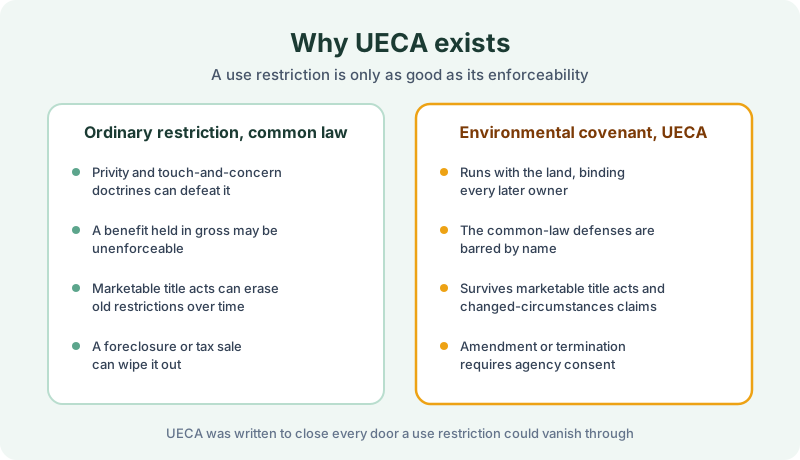
Here’s the uncomfortable history: for a long time, nobody was sure these restrictions would hold up. The common law of covenants and servitudes was built for neighborhood disputes, not remediation, and it came loaded with doctrines that could kill a use restriction: requirements of privity between the parties, the rule that a covenant must “touch and concern” the land, hostility to benefits held “in gross” by someone who owns no nearby land (which is exactly what an agency’s enforcement right is). Layer on marketable title acts that extinguish old restrictions after a few decades, changed-circumstances arguments, and the risk that a tax foreclosure wipes the record clean, and you have a real question: what happens to “no one may drill a well here” thirty years and four owners later?
For a restriction that’s the load-bearing wall of a risk-based remedy, “probably enforceable” wasn’t good enough.
UECA’s answer
The Uniform Environmental Covenants Act, completed by the Uniform Law Commission in 2003 and since adopted in roughly half the states plus the District of Columbia, was written to shut those doors one by one. Under UECA, a compliant environmental covenant:
- Runs with the land, binding every later owner and occupant
- Survives the old common-law defenses by name: lack of privity, benefit in gross, touch and concern, and the rest are expressly no defense
- Outlasts the doctrines that erode ordinary restrictions, including marketable title acts and changed-circumstances arguments
- Is shielded from later foreclosures, and agencies typically require prior lienholders to subordinate so an old mortgage can’t wipe it out
- Can’t be quietly amended or terminated: changes require the agency’s consent, not just a deal between buyer and seller
States that haven’t adopted UECA aren’t unregulated; they run their own versions under their own names: deed notices, notices of activity and use limitation, environmental land use restrictions. The labels differ, but the design goal is the same, and so is the place they live: the county land records.
Why a buyer should care
If you’re buying property with an environmental covenant on it, you’re inheriting its obligations on the day you take the deed, and you can’t negotiate them away without the agency. The covenant may also be doing quiet work for you: honoring recorded use restrictions is one of the continuing obligations that keep CERCLA’s purchaser protections alive after closing. Either way, the worst time to learn its terms is after the site plan is drawn, a lesson brownfield redevelopers know well.
Built to be found
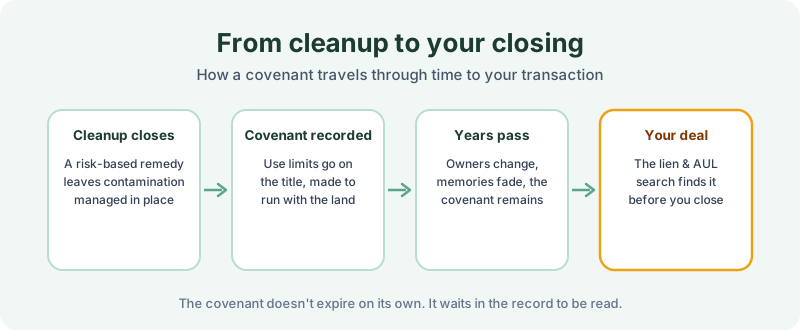
An environmental covenant only works because it’s recorded, which also means it’s findable. Our 1980 Environmental Lien & AUL report is built for exactly this: certified title abstractors review land title and judicial records from 1980 to the present and document every environmental lien, encumbrance, and AUL found, with the recorded instruments attached so you can read the actual terms. It’s $425, delivered by email in 3–5 business days. Order online, and if a covenant does turn up, here’s how to think about it.
Get an E1527-21 compliant lien & AUL report
Our 1980 Environmental Lien & AUL reports are researched by certified title abstractors, cover judicial records, and are guaranteed accurate. Delivered in 3–5 business days.
or call 877-848-5337