
Published
A timber company is buying twelve thousand acres across four townships, and somebody has to do the environmental due diligence. There are no buildings, no utility connections and almost nobody to interview, and the ordinary Phase I standard assumes all three. ASTM wrote a separate standard for exactly this situation, and its current revision is E2247-23.
What the standard is for
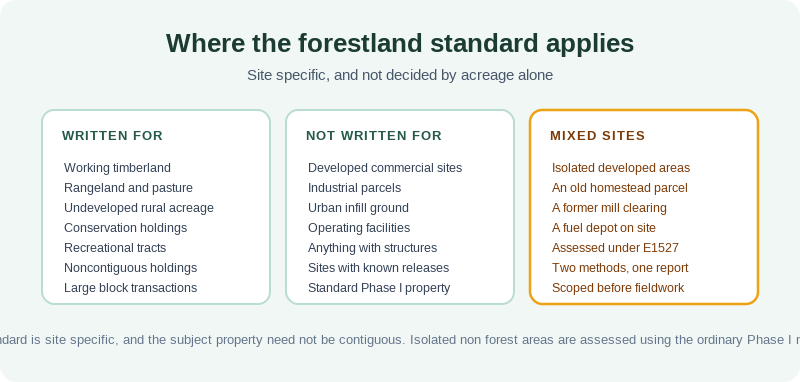
E2247 is the Phase I environmental site assessment process for forestland or rural property. It exists because the ordinary standard was built around a walkable parcel with defined boundaries, visible utilities, observable adjoining uses and occupants who can be interviewed, and a working timber tract supplies almost none of that.
The standard is site specific rather than acreage based. The subject property need not be contiguous, and it may contain isolated areas that are neither forestland nor rural. Those isolated areas are assessed using the ordinary Phase I methods, which means a single report can run two methods across one transaction. Scoping that split before fieldwork starts is the practical first step.
Where EPA stands on it
This matters because the standard only does the user any good if it satisfies the statutory obligation. EPA amended the all appropriate inquiries rule to reference E2247-23 as a way of satisfying those requirements. In the same 2024 rulemaking the agency stated that it would remove its recognition of the earlier E2247-16 revision one year after that action.
The practical reading is to work to the current revision and confirm which revisions the agency recognizes at the time of your engagement, rather than relying on a consultant’s template. Recognition of older revisions has been withdrawn before, and it will be again.
It is also worth deciding which standard the engagement letter names. A report produced under E2247 on ground that a reviewer later characterizes as developed commercial property is a weak position to argue from, and so is an ordinary Phase I stretched across twelve thousand acres of timber. The scoping decision is the one that carries the defense, and it is made before anybody goes to the site.
What changes in the field, and what does not
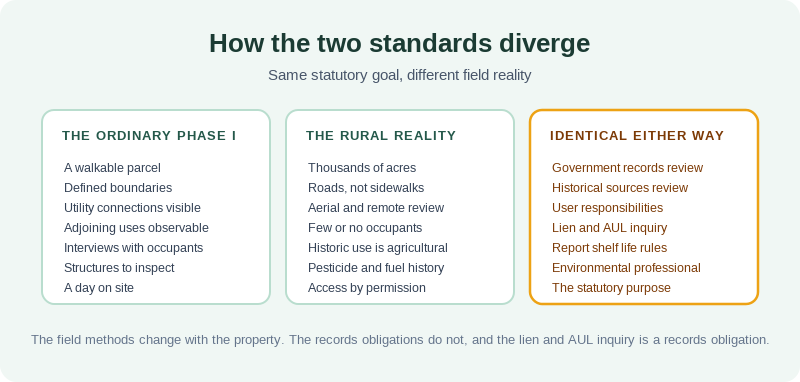
The field methods change a great deal. Thousands of acres get reviewed by aerial imagery, remote sensing and road traverses rather than by a walk of the boundary. There are few occupants to interview. The historical use that matters is agricultural and silvicultural, which means pesticide and herbicide application history, fuel and equipment storage, old burn areas, former mill sites and abandoned homesteads. Access often requires permission from a party who is not the seller.
What does not change is the records side. Government records review, historical sources review, user responsibilities and the shelf life rules all carry across unchanged, and so does the requirement that an environmental professional conducts the assessment. The standard historical sources are the same sources, and the shelf life runs the same way.
The lien and AUL inquiry is a records obligation
Which brings us to the part this site exists for. The environmental lien and activity use limitation inquiry is a records obligation, not a field observation, so it does not get easier or lighter because the property is rural. It is one of the user’s own responsibilities rather than something the consultant absorbs.
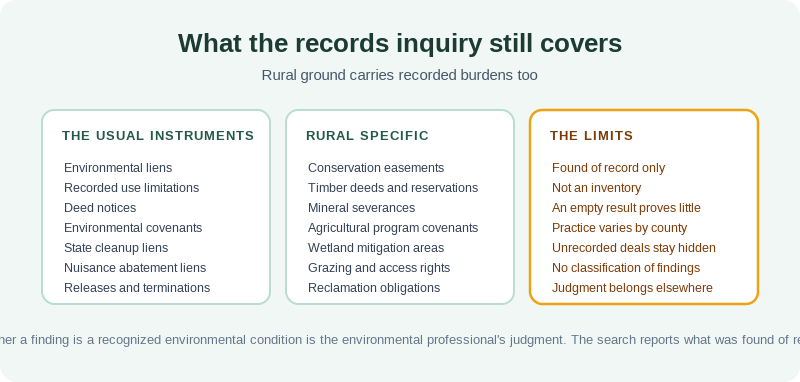
Rural ground carries recorded burdens of its own on top of the usual instruments. Conservation easements, timber deeds and reservations, mineral severances, agricultural program covenants, wetland mitigation areas, grazing and access rights, and reclamation obligations on former quarry and mine ground all sit in the same index as the environmental instruments. A search run across a large multi parcel holding has to cover every original tract, because a restriction recorded in 1958 describes the acreage as it existed then.
What a clean report establishes
Less than people hope, and that is worth saying in the cover letter. A search reports what was found of record in the counties searched, over the term searched, under the names run. It is not an inventory of everything affecting the land, an empty result does not prove a tract is unrestricted, and recording practice varies county by county. Whether a finding is a recognized environmental condition remains the environmental professional’s judgment rather than the search’s.
The 1980 Environmental Lien & AUL report is how we cover that obligation. Certified title abstractors review land title and judicial records from 1980 to the present and document every environmental lien, encumbrance, and AUL found, with the recorded instruments attached. It’s $425, delivered by email in 3-5 business days. Order online, or read the frequently asked questions first. On a multi tract acquisition, see also portfolio and multi site searches.
Get an E1527-21 compliant lien & AUL report
Our 1980 Environmental Lien & AUL reports are researched by certified title abstractors, cover judicial records, and are guaranteed accurate. Delivered in 3–5 business days.
or call 877-848-5337