Published
A buyer orders a Phase I, the report comes back with no recognized environmental conditions, and six weeks after closing somebody discovers the building is full of asbestos containing floor tile. Nothing went wrong with the assessment. Asbestos is a non scope consideration, the standard does not require anybody to look for it, and unless the engagement asked for it nobody did. The same thing happens with radon, with wetlands, and increasingly with PFAS. Understanding the boundary matters as much as understanding what an activity and use limitation actually requires, because both are about what a document covers rather than what it concludes.
What a non scope consideration is
ASTM E1527-21 sets out its own limits explicitly, and the practice is confined to the scope stated in the standard. Anything else is a non scope consideration, also called a business environmental risk, and it is handled as a separate scope of work with its own cost. The 2021 revision made this more visible by naming emerging contaminants, including per and polyfluoroalkyl substances, as non scope items rather than folding them into the baseline.
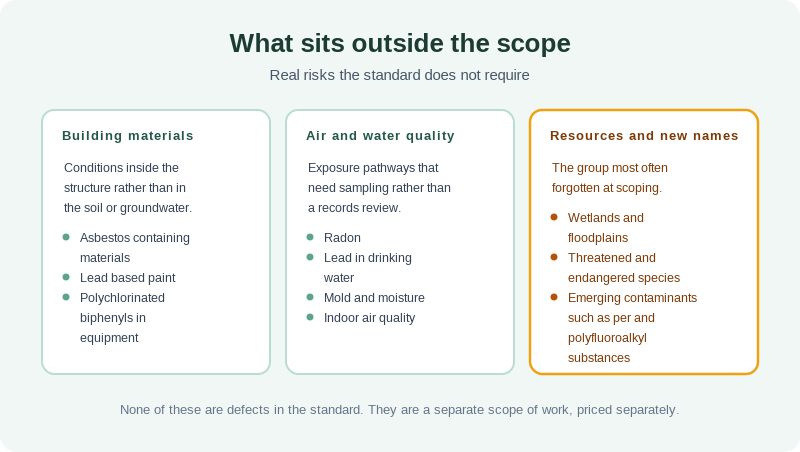
The list breaks into groups. Building materials such as asbestos containing materials, lead based paint and polychlorinated biphenyls in older equipment. Air and water quality items including radon, lead in drinking water, mold and indoor air quality, most of which need sampling rather than a records review. And natural resource and emerging contaminant items such as wetlands, floodplains, threatened and endangered species, and the newer chemistries. That last group is the one most often forgotten at scoping. It is also the group most likely to change, since a chemistry nobody was asking about five years ago can become a standing lender question without the standard itself being revised at all.
Who decides to add one
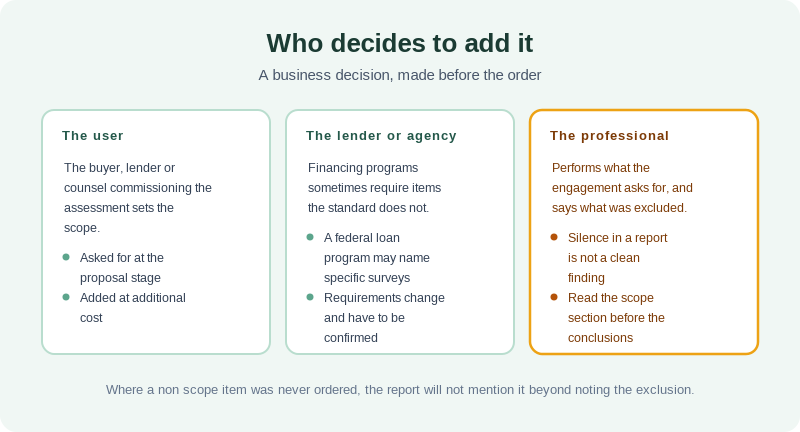
The decision belongs to the user, which is the buyer, lender or counsel commissioning the work, and it is made at the proposal stage rather than afterward. Some financing programs require specific items the standard does not, so a federally supported transaction can carry obligations a conventional one does not, and those requirements change often enough that they have to be confirmed rather than assumed. The environmental professional performs what the engagement asks for and states what was excluded. That exclusion language is why a report should be read from the scope section forward, since silence about asbestos in a report that never covered asbestos is not a clean finding. The same discipline applies to the user responsibilities the rule assigns to the buyer.
Why the all appropriate inquiries line matters
The federal rule defines what has to be done to establish the landowner liability protections, and the environmental professional’s inquiry is the largest piece of it. EPA recognizes the 2021 standard as satisfying that rule. Non scope items sit outside the baseline the rule describes, which has a practical consequence. Adding them does not strengthen a liability defense, and leaving them out does not weaken one. They are commercial risk rather than statutory compliance, and they are worth buying for exactly that reason on a building you intend to occupy or renovate. The relationship between the standard and the rule is set out in our guide to the ASTM E1527-21 rule and in the note on the all appropriate inquiries rule.
What the records side still covers
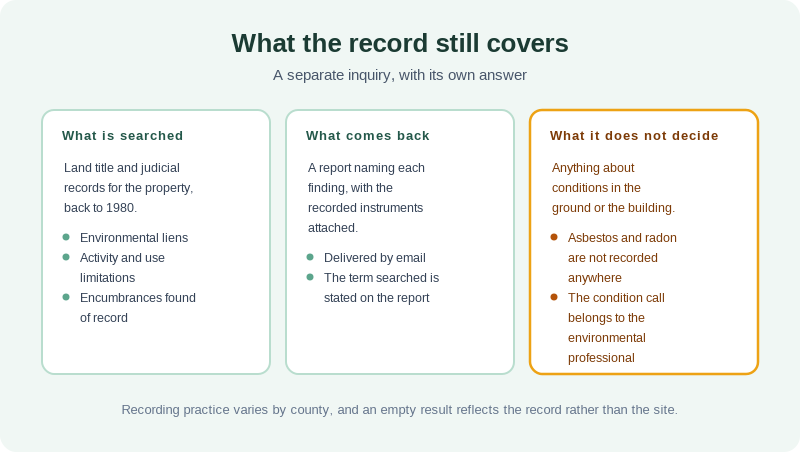
The title and judicial records search is itself a defined piece of the inquiry rather than a non scope item, and it answers a different question from any of the above. It reports environmental liens, activity and use limitations and encumbrances found of record against the property, with the instruments attached. It decides nothing about conditions, because asbestos and radon are not recorded anywhere. The recognized environmental condition call belongs to the environmental professional, as covered in REC, CREC and HREC in a Phase I ESA, and a clean lien report reflects the record rather than the building. Recording practice varies by county, and our FAQ explains how thin or unindexed counties are handled.
The takeaway
Decide what you are buying before the proposal is signed, and read the scope section before the conclusions. A Phase I done to the standard is not incomplete when it omits radon, it is simply a different product from the one that includes it. The 1980 Environmental Lien & AUL report covers the records side, where certified title abstractors review land title and judicial records from 1980 to the present and document every environmental lien, encumbrance, and AUL found, with the recorded instruments attached. It’s $425, delivered by email in 3–5 business days. Order online, or see a sample report first.
Get an E1527-21 compliant lien & AUL report
Our 1980 Environmental Lien & AUL reports are researched by certified title abstractors, cover judicial records, and are guaranteed accurate. Delivered in 3–5 business days.
or call 877-848-5337