
Published
Batch plants occupy a recognizable kind of site. Several acres of flat ground with rail or highway access, usually on the edge of a town, usually zoned industrial for as long as anybody remembers. When the plant closes the equipment has salvage value and gets removed, and what is left looks like a vacant yard.
These parcels redevelop constantly, because the location is good and the asking price reflects an empty lot rather than an industrial history. For a buyer or a lender, the environmental lien and use limitation search is one of the few parts of diligence that can be completed quickly, and it is worth understanding what it does and does not reach.
What the operation left behind
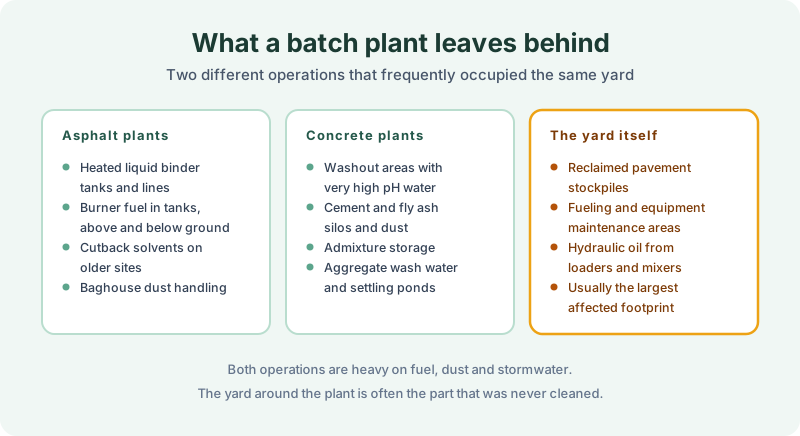
Asphalt and concrete plants are different operations that frequently shared a yard, and the two leave different signatures.
An asphalt plant runs on heat and fuel. Liquid binder is stored hot in tanks with heated transfer lines, the dryer burns fuel oil or diesel held in storage, and older plants used cutback asphalt thinned with petroleum solvents. Dust is collected in a baghouse and has to go somewhere.
A concrete plant runs on water and dust. Washout from trucks and mixers produces highly alkaline water that was commonly discharged into an unlined pit, cement and fly ash are stored in silos and handled in quantity, and aggregate washing generates sediment ponds.
The yard is the part that gets underestimated. Equipment fueling and maintenance, hydraulic systems on loaders and mixers, and reclaimed pavement stockpiles cover more ground than the plant did, and nobody treated the yard as part of the plant.
What reaches the land record
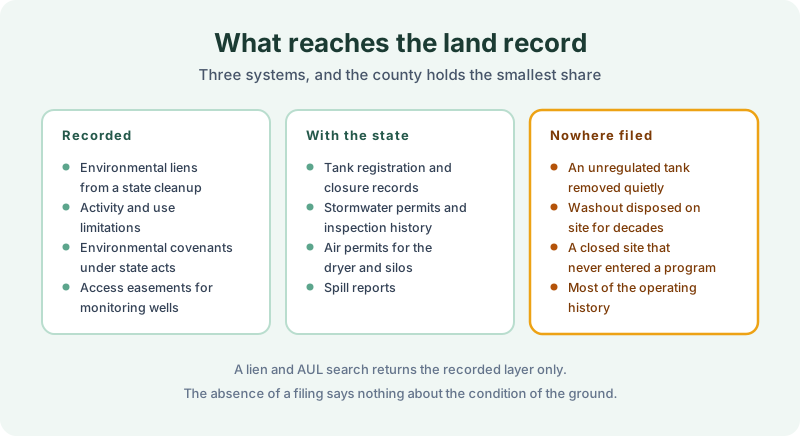
The recorded layer is narrow and specific. An environmental lien filed by a state after a cleanup, an activity and use limitation restricting how the ground may be used, an environmental covenant under a state act, and occasionally an access easement permitting somebody to maintain monitoring wells. That is close to the whole of it, and it is what the search described in how an environmental lien and AUL search is performed returns.
Most of the operating history sits with state agencies instead. Tank registration and closure records, stormwater permits and their inspection history, air permits for the dryer and the silos, and any spill reports.
And a great deal of it was never filed anywhere. A plant that operated from 1961 to 1994, removed its own tanks, and closed without entering any cleanup program leaves a county record that is entirely silent. That silence is the point made in data gaps in an environmental lien search, and it is not evidence of a clean site.
Where the pressure sits in a transaction
Two things tend to drive the timeline.
The first is that these sites are attractive to buyers who want to build quickly, which means the record search runs early and the subsurface work runs late or not at all. The order in environmental due diligence timeline is worth holding to even when the schedule argues against it.
The second is that stockpiles stay on site. Reclaimed asphalt pavement has value and it sits in piles for years, and a buyer acquiring the parcel acquires the piles. Whether that material is a product or a waste is a regulatory question with consequences, and it is not answered by anything in the land record.
Scoping the search
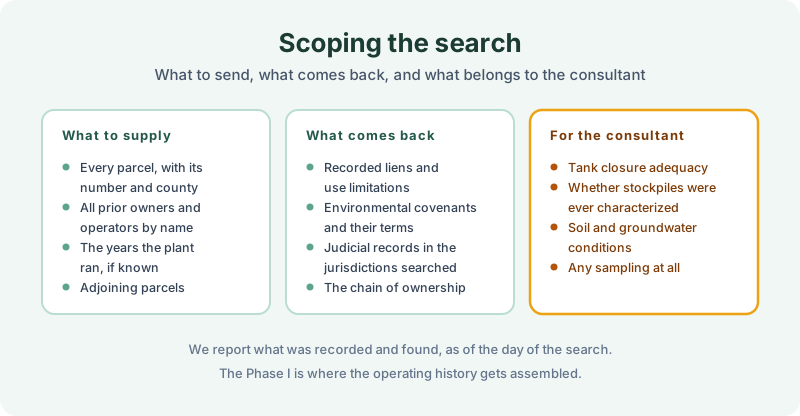
Give us every parcel with its number and county, all prior owners and operators by name, and the years the plant ran if you have them. Operator names matter because a lien is indexed against a name as well as against land, which is why adjoining property environmental lien search is a separate request worth making on a site like this.
We return the recorded liens and use limitations, any environmental covenant with its terms, judicial records in the jurisdictions searched, and the ownership chain. Tank closure adequacy, stockpile characterization and anything about soil or groundwater belongs to the environmental professional, and the division is the one set out in user responsibilities under a Phase I ESA.
The takeaway
A flat industrial yard with highway access and no buildings on it has a history, and batch plants are one of the most common versions of that history. The recorded search is fast and it covers a narrow layer. Run it early, read a clean result as the absence of filings rather than the absence of contamination, and keep the subsurface work in the schedule.
Order a search, see what the 1980 search covers, or read the FAQ.
Get an E1527-21 compliant lien & AUL report
Our 1980 Environmental Lien & AUL reports are researched by certified title abstractors, cover judicial records, and are guaranteed accurate. Delivered in 3–5 business days.
or call 877-848-5337