Published
A clean search result is only as good as the search behind it, and every records search has edges. Indexes start in a certain year. A book burned. A covenant was recorded against a parcel that no longer exists under that description. ASTM E1527-21 has a name for this and a rule about it, and the rule is not that gaps are forbidden. It is that they have to be found, written down, and evaluated. Understanding that changes how you read the output of a lien and AUL search.
What ASTM means by a data gap
The standard defines a data gap as a lack of or inability to obtain information required by the practice, despite good faith efforts to get it. The environmental professional must identify each gap, comment on its significance, and say how it affects the ability to reach conclusions. A significant data gap is one that affects the professional’s ability to identify a recognized environmental condition.
Two things follow from that wording. First, gaps do not by themselves break All Appropriate Inquiries. Second, an undisclosed gap does, because the professional cannot comment on something nobody told them about. Records gaps are the environmental professional’s to evaluate, and the abstractor’s to surface.
The practical consequence shows up on the report, not in the file. A consultant who knows the 1974 to 1986 grantee books were unavailable can decide whether the site’s operating history makes that range worth chasing, price a targeted follow up, or write the gap up as insignificant with a reason. A consultant who is handed a bare negative result has to choose between assuming the search was complete and re ordering work that may already have been done.
Where the gaps actually come from
Records gaps are ordinary, and most of them come from four places.
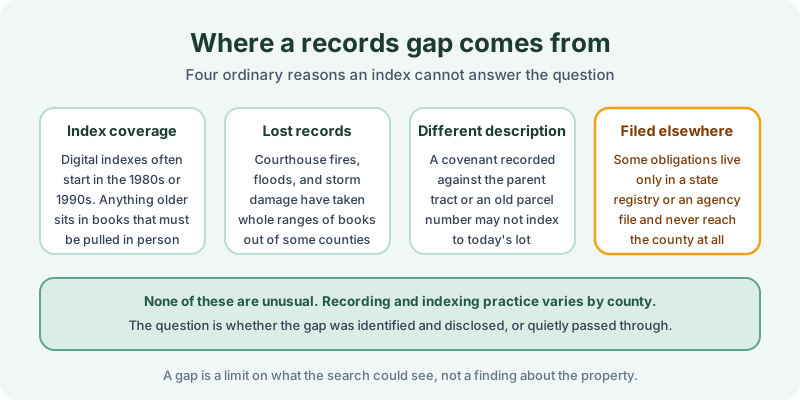
Index coverage is the most common. Plenty of counties put their grantor and grantee indexes online starting in the 1980s or 1990s, and the earlier years live in bound books at the counter. Lost records are less common but real, and a county that lost a range of books to a fire cannot produce them for anyone. Descriptions shift when land is split, so an instrument recorded against a parent tract may not index to today’s lot. And some obligations are filed somewhere else entirely, in a state registry or an agency file rather than the county land records.
The ones that can be closed
Several of these gaps are only gaps if you stop at the online index.
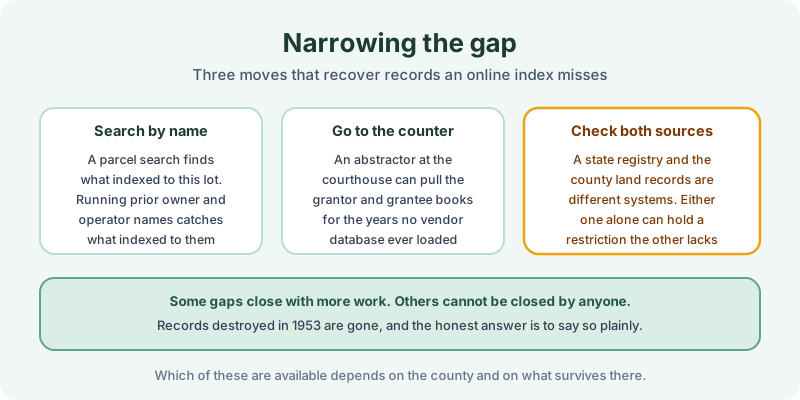
Searching by prior owner and operator name picks up instruments that indexed to a person or company rather than to the parcel. Sending someone to the counter recovers the years no vendor database ever loaded. Checking a state registry alongside the county records covers restrictions that exist in one system and not the other, which happens in both directions. And where a parcel came out of a larger tract, following the chain of title back through the split is what makes a search of the parent description possible at all, an issue that comes up constantly when a parcel has been subdivided.
Other gaps cannot be closed by anybody. When the books are gone, the honest response is to say which years are missing and let the professional weigh it. Cost and schedule enter here too. Pulling books by hand in a county three states away takes time that a rushed diligence window may not have, which is an argument for ordering the records work early rather than for skipping it.
What goes in the report
This is where a records vendor’s habits matter more than its coverage claims.
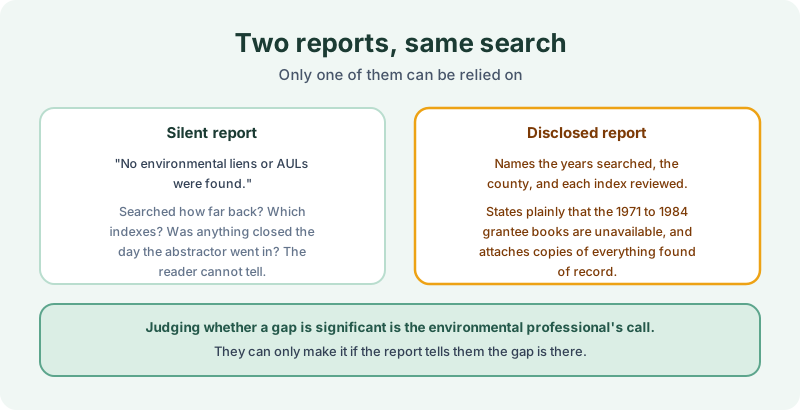
A report that says only “nothing found” gives a consultant nothing to evaluate. A usable report names the county, the years searched, the indexes reviewed, any index that was unavailable and why, and attaches copies of every instrument found of record so the wording can be read rather than paraphrased. A search reports what has been recorded and indexed in that county. It is not an inventory of everything true about a site, and an empty result is not proof that no restriction exists.
The scope question comes before the search
Most data gap arguments are really scope arguments that nobody had in advance. Deciding early how far back to go, which names to run, and which parcel descriptions apply is cheaper than discovering the question at closing, and it is a conversation worth having before the order goes in. Our 1980 Environmental Lien & AUL report is built for that: certified title abstractors review land title and judicial records from 1980 to the present and document every environmental lien, encumbrance, and AUL found, with the recorded instruments attached, and the search parameters stated. It’s $425, delivered by email in 3–5 business days. Order online, or read what the report covers section by section first.
Get an E1527-21 compliant lien & AUL report
Our 1980 Environmental Lien & AUL reports are researched by certified title abstractors, cover judicial records, and are guaranteed accurate. Delivered in 3–5 business days.
or call 877-848-5337