Published
Most of the site archetypes in this archive announce themselves. A plant, a yard, a tank farm, something a historic aerial photograph will show. A field that received treated sewage sludge under a land application program announces nothing at all. It is row crop or hay ground, it was farmed before and after, and the only physical trace was a truck and a spreader working for a few days a season. It belongs in the same category as our note on orchard farmland with arsenic, where the history is agricultural and the concern is not.
How the material got there
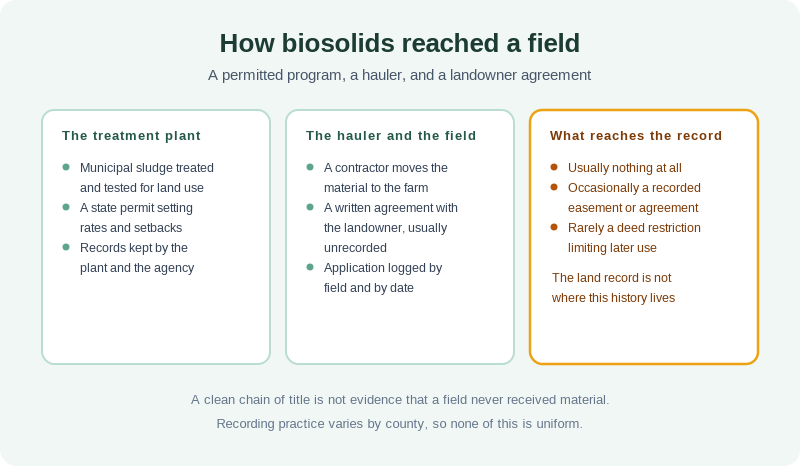
A municipal treatment plant produces sludge, treats it to a standard that allows land use, and has it tested. A state permit sets application rates, buffer distances from wells and surface water, and the crops that may follow. A contractor hauls the material to a farm, and the farmer takes it because it replaces fertilizer at no cost.
The agreement between the plant and the landowner is a private contract. It is almost never recorded, the permit lives with the agency, and the application logs sit with the plant and the hauler. That is the whole arrangement, and from the county recorder’s point of view it never happened.
Why the history is hard to find
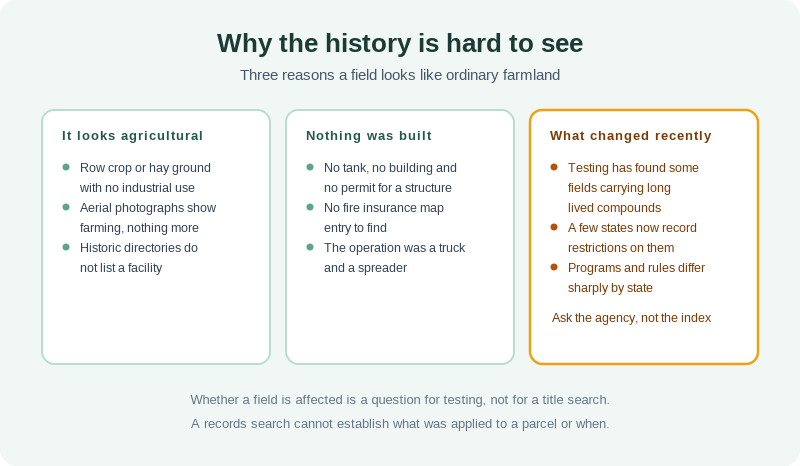
Three things work against a researcher. The ground looks agricultural in every historical source, so aerials, directories and fire insurance maps return farming and nothing else. Nothing was built, which means no permit for a structure, no tank registration and no building footprint to notice. And the operation was mobile, so there is no address that identifies it.
What has changed is the testing. Sampling in several states has found fields that carry long lived compounds associated with the material applied to them, some agencies have issued advisories on specific farms, and a few states have begun recording restrictions against affected parcels. Programs and rules differ sharply from one state to the next, and none of this is uniform or settled.
Where it shows up in a transaction
Three situations bring these fields into a file. The first is a farm sale, where a buyer is pricing ground on yield and a restriction on crops or on grazing changes the number. The second is development, where farmland on the edge of a growing town is being bought for houses and soil that was fine under corn becomes a different question under a subdivision. The third is lending, where an agricultural lender taking a mortgage wants to know whether the collateral carries a recorded limit.
In each of them the client is usually working from a state program list or a neighbor’s account rather than from anything in a report, and the research runs backwards from a rumor. That is not a comfortable position, and it is why the recorded search is worth running even on an archetype where the record is thin. A recorded restriction, if one exists, is the one piece of this history that binds the land rather than describing it, and finding it early is cheaper than finding it at closing.
Researching one anyway
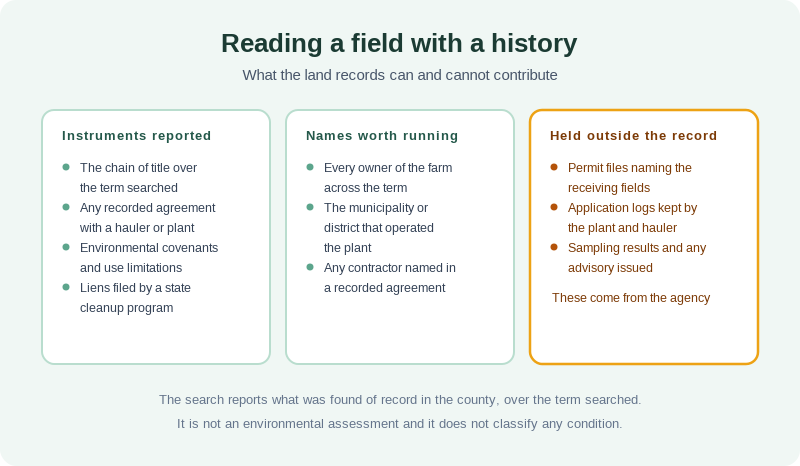
The land records still carry what little got recorded. Over the term searched we report the chain of title, any recorded agreement with a hauler or a treatment plant, environmental covenants and activity and use limitations, and liens filed by a state cleanup program. Where a state has started recording restrictions, that is where they will appear.
Names matter as much as the parcel here. Run every owner of the farm across the term, the municipality or sanitary district that operated the plant, and any contractor named in a recorded instrument. Our note on portfolio and multi site searches covers how that works across a set of fields rather than one.
The decisive file sits with the agency. Permit records naming the receiving fields, application logs kept by the plant and the hauler, and any sampling result or advisory are public records in most states, and they are requested from the agency rather than the recorder. Whether any of it amounts to a recognized environmental condition is the environmental professional’s judgment, not a search result, which is the line drawn in our note on what a Phase II changes.
The takeaway
A clean chain of title on farmland is not evidence that nothing was ever applied to it, and that is worth saying plainly to a client who reads an empty report as an all clear. A records search reports what was found of record in the county searched over the term searched, and on this archetype the record is thin by design.
The 1980 Environmental Lien & AUL report is where the recorded half gets done. Certified title abstractors review land title and judicial records from 1980 to the present and document every environmental lien, encumbrance, and AUL found, with the recorded instruments attached. It’s $425, delivered by email in 3-5 business days. Order online, or see the frequently asked questions for what we need to scope a rural parcel.
Get an E1527-21 compliant lien & AUL report
Our 1980 Environmental Lien & AUL reports are researched by certified title abstractors, cover judicial records, and are guaranteed accurate. Delivered in 3–5 business days.
or call 877-848-5337