
Published
A Phase I raises a hypothesis and a Phase II tests it with a drill rig and a laboratory. That is a different kind of work from reading a chain of title, and the relationship between the two is more interesting than it first appears. A Phase II does not supersede the records search. It changes what the records search is likely to find next, because a finding can start a sequence that eventually produces recorded instruments. The sequencing is the same one set out in the environmental due diligence timeline.
What a Phase II adds
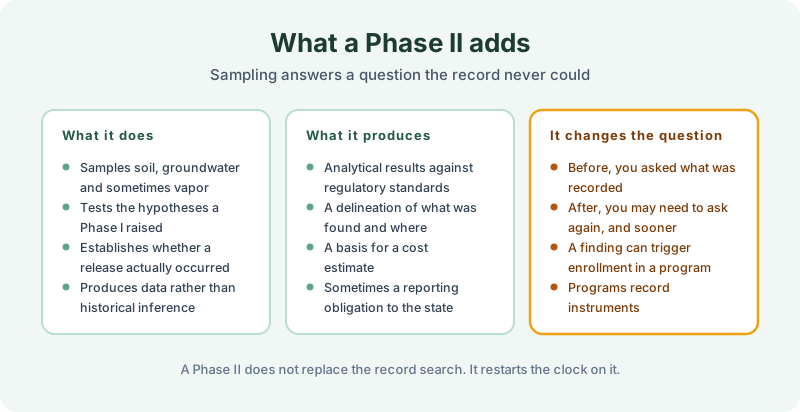
It samples soil, groundwater and sometimes soil vapor, tests the specific hypotheses the Phase I raised, establishes whether a release actually occurred, and produces data rather than historical inference.
What it produces is analytical results measured against regulatory standards, a delineation of what was found and roughly where, a basis for a cost estimate, and in some states a reporting obligation that attaches the moment somebody knows.
What it changes is the question you were asking the record. Before sampling, the search answered what had been recorded as of a date. After a finding, the useful question becomes what will be recorded, and when, because a finding frequently leads into a program and programs produce instruments.
What a finding sets in motion
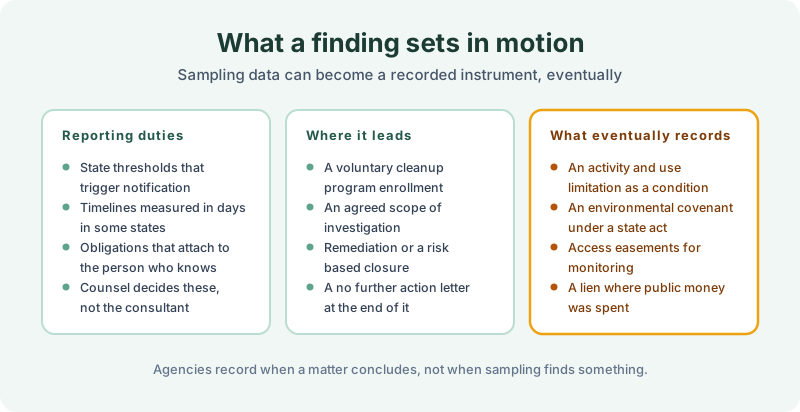
Reporting duties come first and they are the part people are least prepared for. Several states set notification thresholds with timelines measured in days, the obligation attaches to the party who knows, and whether it is triggered is a legal question rather than a consultant’s call.
Where it leads is usually a program. Enrollment in a voluntary cleanup scheme, an agreed scope of investigation, remediation or a risk based closure, and a no further action letter at the end, with all the qualifications set out in what a no further action letter actually means.
What eventually records is the familiar set. An activity and use limitation imposed as a condition. An environmental covenant under a state act. Access easements for monitoring. And a lien where public money was spent. None of it records at the moment of sampling. Agencies record when a matter concludes, which is months or years later, and that lag is the whole reason for a second search.
Why the lag is so long
Because the recording event is the conclusion of a regulatory process rather than the start of one, and those processes run on their own time.
A release found in March produces a report, then a scope agreed with an agency, then fieldwork, then review, then a decision, and only at the end of that does an instrument get drafted and filed. Two years is unremarkable. Where remediation is involved it can be considerably longer, and where a state is funding work the lien securing its costs frequently records after the work is finished rather than before it starts.
The practical consequence is that a property can be actively in a program and entirely silent in the land record for the whole period. A searcher looking in month six finds nothing, reports nothing, and is correct. That is the same structural lag described in how an environmental lien and AUL search is performed.
When to search again
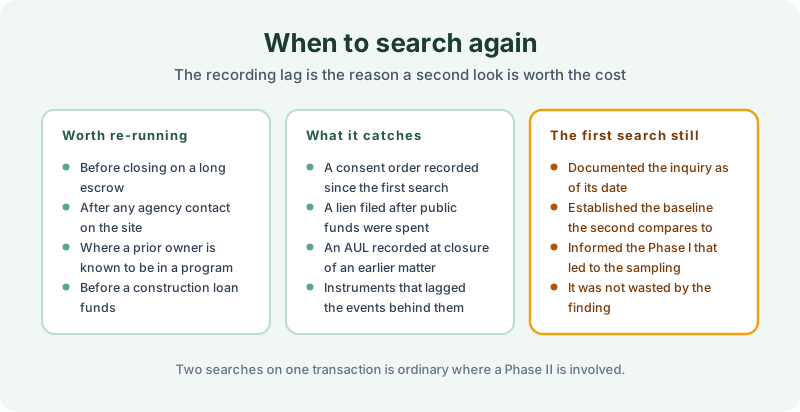
Four triggers are worth acting on. Before closing on a long escrow. After any agency contact concerning the site. Where a prior owner is known to be enrolled in a program. And before a construction loan funds, which is the case made in an environmental lien search for a construction loan.
What a second search catches is a consent order recorded since the first, a lien filed after public funds were spent, or an AUL recorded at the closure of a matter that was already underway when you first looked. Each of those lagged the event behind it, which is precisely why the first search missed them.
And the first search was not wasted by the finding. It documented the inquiry as of its date, which is what the statutory protections require. It established the baseline the second search compares against. And it informed the Phase I that led to the sampling in the first place.
The takeaway
A Phase II answers what is in the ground and the record answers what has been filed about it, and the gap between the two is measured in years. Where sampling finds something, assume the record will eventually say so, and plan a second search rather than treating the first as final.
The 1980 Environmental Lien & AUL report is how the recorded side gets documented at each point. Certified title abstractors review land title and judicial records from 1980 to the present and document every environmental lien, encumbrance, and AUL found, with the recorded instruments attached. It’s $425, delivered by email in 3–5 business days. Order online, or see a sample report first.
Get an E1527-21 compliant lien & AUL report
Our 1980 Environmental Lien & AUL reports are researched by certified title abstractors, cover judicial records, and are guaranteed accurate. Delivered in 3–5 business days.
or call 877-848-5337