
Published
Golf courses have been closing faster than they open for most of two decades, and the ground they leave behind is attractive to developers for obvious reasons. It is large, it is flat in the right places, it already has drainage, and it sits inside established neighborhoods. It also has a maintenance history that nobody driving past would guess, which is why a course conversion belongs in the same category as the sites in our note on former orchard farmland and arsenic, where the use looked benign and the chemistry did not.
What a golf course leaves behind
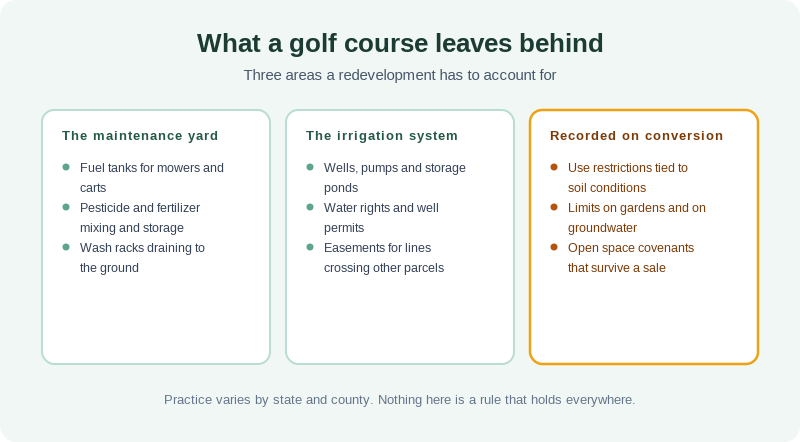
The maintenance yard is the concentrated part of the site. It typically held fuel tanks for mowers and carts, a mixing and storage area for pesticides and fertilizers, and a wash rack where equipment was rinsed down, often draining straight to the ground. On a two hundred acre property, the area that matters most is frequently under two acres.
The irrigation system is the diffuse part. Wells, pumps and storage ponds, with water rights and well permits attached to them, plus easements for lines that cross parcels the course no longer owns. Those easements outlive the course and show up in the record of neighboring properties.
The third area is what gets recorded when the course is converted. Use restrictions tied to soil conditions, limits on vegetable gardens or on groundwater use, and open space covenants that survive the sale. Those are land records, and they are exactly what a lien and limitation search is built to find.
Names on a course parcel
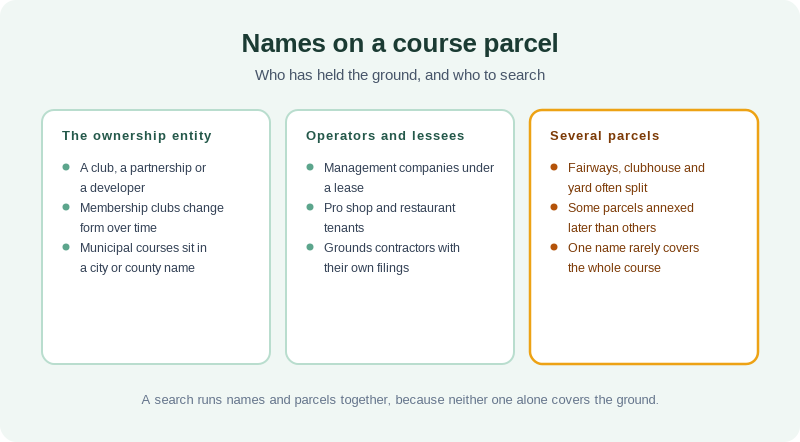
Ownership is rarely simple. A course may have been a club, a partnership or a developer’s amenity, and membership clubs in particular change legal form over the decades. Municipal courses sit in a city or county name, which complicates a search in a different way, since public bodies are not always indexed as cleanly as private ones.
Operators matter as much as owners. Management companies held leases, pro shop and restaurant tenants had their own filings, and grounds contractors occasionally appear in the record on their own account.
And the ground is usually several parcels, not one. Fairways, clubhouse and maintenance yard are frequently separate, some were annexed later than others, and no single name covers the whole property. A search has to run names and parcels together to reach it.
Why the chain matters more than the acreage
A course that operated from 1962 to 2019 passed through several regulatory eras, and the chain of title is the cheapest way to date them. Arsenical pesticides were in normal turf use into the 1970s, chlorinated products followed, and the practices that governed a mixing area changed repeatedly across that span. Knowing which owner held the ground in which decade tells the environmental professional where to look rather than telling them what they will find.
The chain also shows the pieces that left. Courses sold off corner parcels for road widening, for a clubhouse condominium, or simply to raise cash, and a maintenance yard occasionally went with one of them. A search scoped to the parcel being bought will miss ground that was once part of the same operation, which is the problem our note on adjoining property describes from the other side of a fence.
Reading a conversion in the record
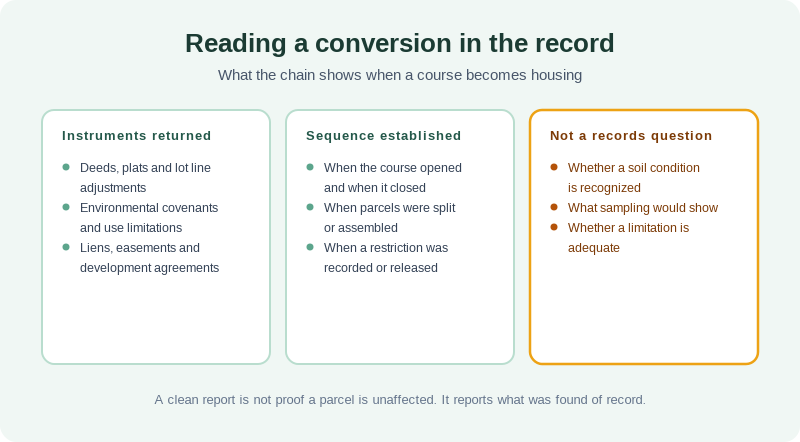
We return the deeds, plats and lot line adjustments, any environmental covenants and activity and use limitations, and the liens, easements and development agreements found of record. From those the chain establishes a sequence, which is usually the most useful output. When the course opened and closed, when parcels were split or assembled, and when a restriction was recorded or released.
What is not a records question is whether a soil condition amounts to a recognized environmental condition, what sampling would show, or whether a recorded limitation is adequate to the risk. Those are calls for the environmental professional, and the standard they work to is set out in our note on the ASTM E1527-21 rule.
Recording practice varies by county, and a clean report is not proof that a parcel is unaffected. It reports what was found of record over the term searched, and the FAQ sets out what that scope covers.
The takeaway
Treat the maintenance yard as the site and the fairways as the context, run the search across every parcel the course occupied rather than the one being bought, and look specifically for restrictions recorded at the moment of conversion, since that is when a seller’s lawyer is most likely to have put something on the record. The sample report shows the form the findings take.
Our 1980 Environmental Lien & AUL report is where this starts. Certified title abstractors review land title and judicial records from 1980 to the present and document every environmental lien, encumbrance, and AUL found, with the recorded instruments attached. It’s $425, delivered by email in 3–5 business days. Order online, or read our note on groundwater use restrictions first if the irrigation wells are the part you are worried about.
Get an E1527-21 compliant lien & AUL report
Our 1980 Environmental Lien & AUL reports are researched by certified title abstractors, cover judicial records, and are guaranteed accurate. Delivered in 3–5 business days.
or call 877-848-5337