Published
A former refinery is among the largest and most complicated assignments in this field, and the reason is not only what was processed there. It is that the site is almost never one parcel, almost never one owner, and almost never neatly bounded by the fence line. Scoping the records work to a single tax parcel will under report the risk, in much the same way it does on a former bulk petroleum terminal, only across a far larger area.
What went on there
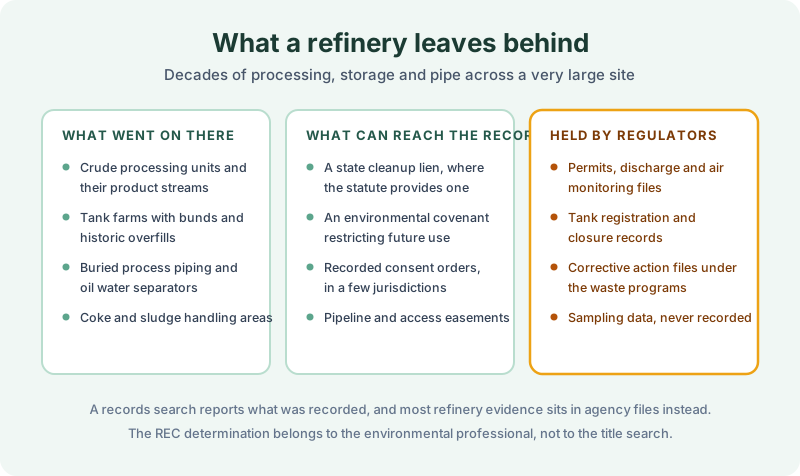
Refining concentrates several distinct legacies on one site. Process units handled crude and its fractions at temperature and pressure for decades. Tank farms held product in bunded areas where overfills and bottom failures were an operational reality rather than an exception. Buried process piping ran everywhere, and a meaningful share of it was abandoned in place rather than removed. Oil water separators, coke handling areas and sludge lagoons dealt with what the units rejected.
Add to that the ordinary industrial support functions, which on a site this size means a maintenance shop, a laboratory, a transformer yard and a wastewater treatment plant, each with its own history.
The parcel problem
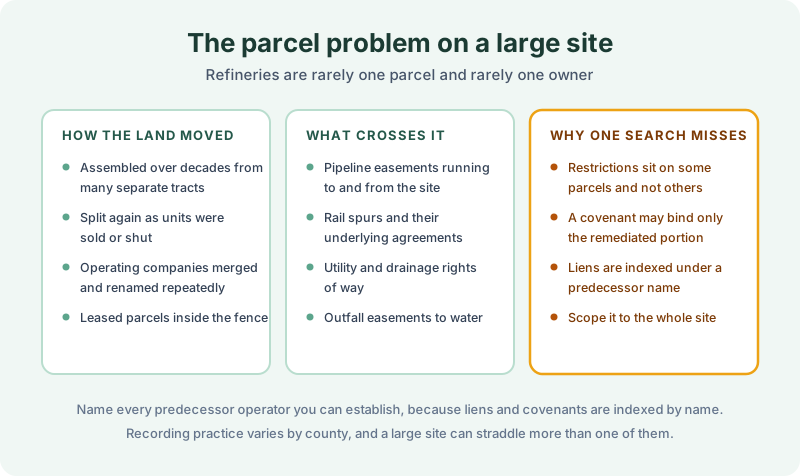
Refineries were assembled over decades out of many separate tracts, expanded as throughput grew, and then split again as units were shut and land was sold off. Operating companies merged, were acquired and renamed themselves repeatedly across the twentieth century, so the entity on a 1962 deed may bear no resemblance to the name anybody uses now. Parts of the site were frequently leased rather than owned, which means an operator with real responsibility may never appear in the chain at all.
Then there is what crosses the land. Pipeline easements running in and out, rail spurs with their own agreements, utility and drainage rights of way, and outfall easements carrying discharge to a river or a bay. Each of those is a recorded interest, each burdens a specific parcel, and together they describe how the site actually functioned.
The practical consequence is that a restriction may sit on one parcel and not its neighbor. A covenant may bind only the portion that was remediated under a particular order. A lien may be indexed under a predecessor name nobody thought to run. Scoping the search to the whole former footprint, and to every operator name the chain produces, is what stops those from being missed.
What can reach the land record
The list is short, and the same one that governs any industrial site.
- A state environmental lien, where the statute provides for one and an agency filed it.
- An environmental covenant or activity and use limitation, restricting use or requiring an engineered cap to remain in place. These are recorded in the states that adopted UECA and held only in a registry elsewhere.
- Groundwater use restrictions, which on a refinery site are common and frequently cover a wide area.
- Access easements for monitoring and remedial equipment.
- Recorded consent orders, in the small number of jurisdictions where that happens at all.
Everything else about the site sits with regulators. Permits and discharge monitoring, tank registration and closure records, corrective action files under the waste programs, and all of the sampling data. None of it is recorded against land and none of it is findable by a search.
Scoping the work
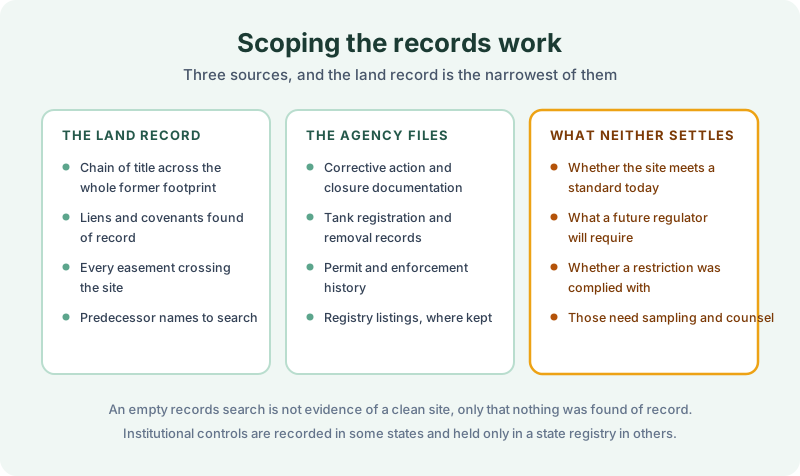
Establish the former footprint first, then run the chain across all of it rather than across the parcel currently under contract. Take every easement crossing the site, because the pipeline and outfall rights tell you where product and water moved. Collect the predecessor operator names as you go, since those are the input that makes the agency file request productive rather than a shot in the dark.
A search reports what was recorded and indexed in the offices searched, over the term searched. It is not an investigation, it does not locate anything on the ground, and an empty result is not evidence that a site is clean. On a refinery it is better read as a statement about what was filed than as a statement about what is there. The REC determination belongs to the environmental professional, and this is one input to it. Recording practice varies by county, and a site this large can straddle more than one.
The 1980 Environmental Lien & AUL report is scoped for this. Our certified title abstractors review land title and judicial records from 1980 to the present and document every environmental lien, encumbrance, and AUL found, with the recorded instruments attached. It’s $425, delivered by email in 3–5 business days. Order online, or read what an AUL actually requires before you scope the assignment.
Get an E1527-21 compliant lien & AUL report
Our 1980 Environmental Lien & AUL reports are researched by certified title abstractors, cover judicial records, and are guaranteed accurate. Delivered in 3–5 business days.
or call 877-848-5337