
Published
Telephone exchanges are being sold off across the country as switching consolidates into fewer buildings. They are structurally sound, they sit on good urban corners, and they come up constantly as conversion candidates. They are also one of the archetypes most likely to produce a short, clean chain of title that tells a buyer almost nothing, which is a different problem from the one presented by a former utility substation next to it.
A plain building with a power plant inside
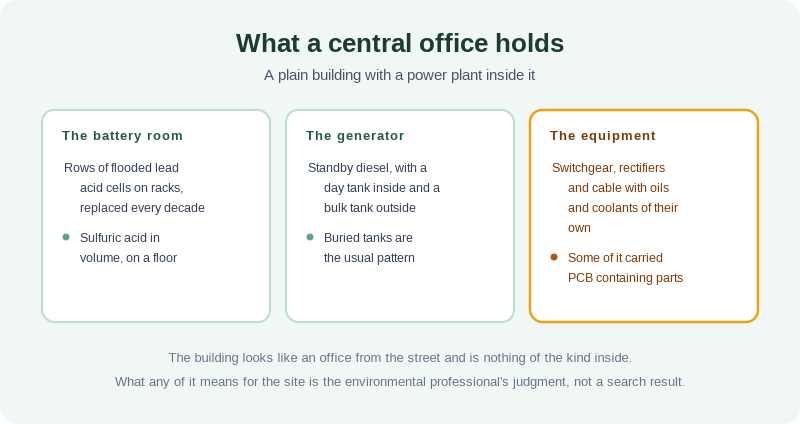
A central office had to stay up when the grid went down, which means every one of them contained a small power plant.
The battery room is the feature to look for first. Rows of flooded lead acid cells sat on racks over a sealed floor, carrying sulfuric acid in real volume and being replaced on a cycle measured in decades. Spills, leaks and the handling of replaced cells all happened in the same room for the life of the building.
The standby generator came with fuel. A day tank inside the building and a bulk tank outside it, and for most of the period in question the bulk tank was buried. That is the single most common finding on these sites and it is frequently absent from any document the seller holds.
The equipment itself is the third piece. Switchgear, rectifiers, cable pressurization systems and cooling equipment carried oils and coolants, and some of the older components contained PCBs. Where that question is live, the battery plant archetype and the substation post both cover related ground.
Halon fire suppression was standard in switch rooms and is a building systems question rather than a soil one. It still belongs on the same checklist, because the date the suppression system went in tells you when the room was last reworked, and a room that was reworked is a room where equipment was removed and taken somewhere.
Why the record is so quiet
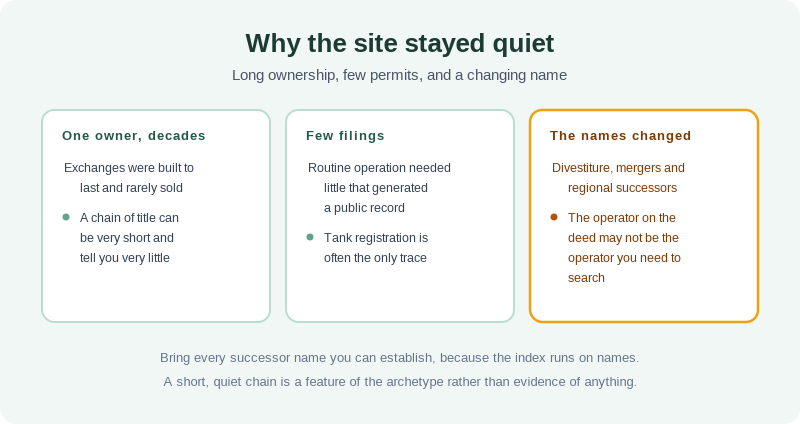
Three things combine to make these sites look uneventful on paper.
Exchanges were built to last and were almost never sold, so a chain of title can run fifty years on two instruments. A short chain is a feature of the archetype rather than evidence that nothing happened.
Routine operation generated very little that reaches a public record. No discharge of note, no manufacturing, no waste stream large enough to attract attention in most years. A tank registration is often the only trace of the thing most likely to matter.
And the names moved. Divestiture, mergers and a succession of regional operating companies mean the entity on the deed may not be the entity that ran the building, which is the same tracing problem set out in chain of title for a Phase I ESA. Bring every successor name you can establish, because a names index cannot search what it was not given.
What a lien and limitation search reads
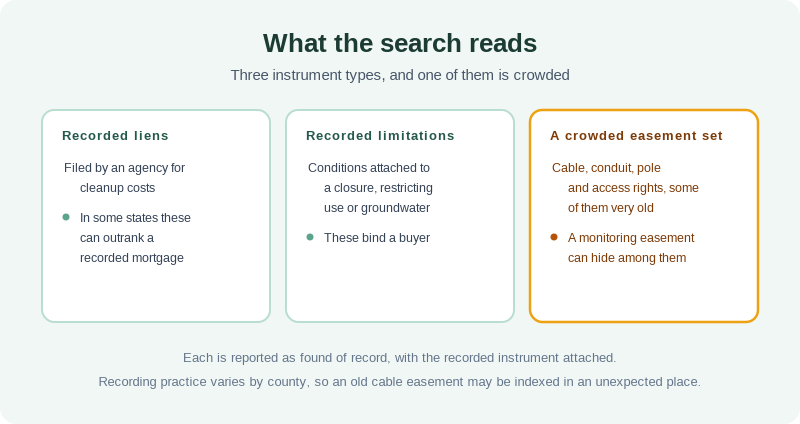
Three instrument types matter here as elsewhere. A recorded environmental lien filed by a state or federal agency for cleanup costs, which in a number of states can take priority over a recorded mortgage. A recorded use limitation where a release was closed with material left in place, typically restricting the use of soil or groundwater. And an access easement for monitoring or treatment equipment.
The easement set is where this archetype differs. A central office parcel carries cable and conduit rights, pole line easements, access rights and sometimes rights that predate the building, and a monitoring easement can sit unremarked among a dozen others. Reading who holds each one is the work. Where a parcel was carved out of a larger block, as many urban exchange sites were, easements serving the rest of that block can run across it, and the instruments creating them are usually older than the building itself. Groundwater use restrictions in the land record covers the limitation side in more detail, and our FAQ sets out how the term is chosen.
The takeaway
A records search reports what was found of record in the indexes reviewed over the term searched, and on this archetype the record is unusually thin, which is information rather than reassurance. A buried fuel tank and a battery room leave nothing in a county index. The 1980 Environmental Lien & AUL report is the product that covers this. Certified title abstractors review land title and judicial records from 1980 to the present and document every environmental lien, encumbrance, and AUL found, with the recorded instruments attached. It’s $425, delivered by email in 3 to 5 business days. Order online.
Get an E1527-21 compliant lien & AUL report
Our 1980 Environmental Lien & AUL reports are researched by certified title abstractors, cover judicial records, and are guaranteed accurate. Delivered in 3–5 business days.
or call 877-848-5337