
Published
A seller produces a no further action letter from the state environmental agency and treats the environmental question as answered. It is a genuinely useful document and it does not say what people take it to say. It says that the agency requires no further action at this time, based on the data submitted, for the exposure scenario evaluated, under the program the site was enrolled in. Every one of those qualifiers is doing work, and three of them can change. The letter belongs with the recorded instruments discussed in voluntary cleanup programs and what gets recorded.
What the letter actually says
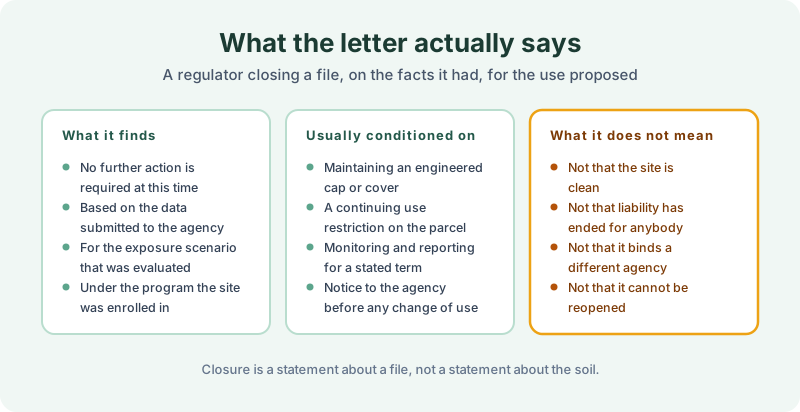
The finding is narrow. No further action required at this time, based on the data submitted to the agency, for the exposure scenario that was evaluated, under that particular program.
It is usually conditioned. Maintaining an engineered cap or cover. A continuing use restriction on the parcel. Monitoring and reporting for a stated term. Notice to the agency before any change of use. Those conditions are the price of the closure and they run with the land.
What it does not mean is the part worth being blunt about. It does not mean the site is clean. It does not mean liability has ended for anybody, since CERCLA and most state statutes reach owners and operators regardless of what a state agency wrote. It does not bind a different agency, so a state closure says nothing about a federal position. And it does not mean the file cannot be reopened.
What it leaves recorded
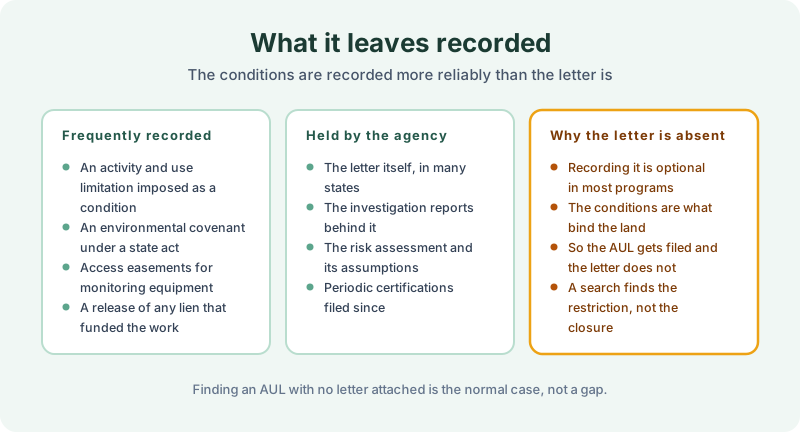
Frequently recorded are the conditions rather than the closure. An activity and use limitation imposed as a condition of the letter. An environmental covenant under a state act. Access easements for monitoring equipment. And a release of any lien that funded the work.
Held by the agency is the letter itself in many states, along with the investigation reports behind it, the risk assessment and its assumptions, and the periodic certifications filed since.
That produces a result that confuses buyers. Finding a recorded AUL with no letter attached is the normal case rather than a gap in the record. Recording the letter is optional in most programs, the conditions are what bind the land, so the restriction gets filed and the closure does not. A search finds the restriction and the agency holds the explanation for it, which is the division set out in how to read an environmental lien and AUL report.
How a closure gets reopened
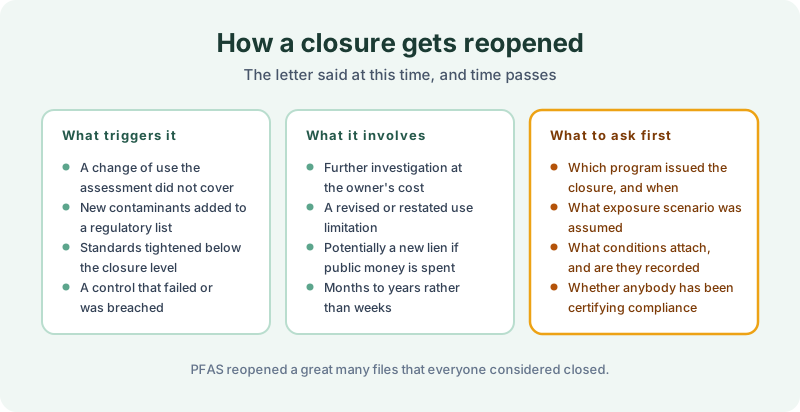
Four triggers account for most of it. A change of use the risk assessment did not cover, which is the commonest by a distance, because closures are frequently granted on a commercial or industrial exposure scenario and residential redevelopment is a different question. New contaminants added to a regulatory list. Standards tightened below the level the closure was granted at. And a control that failed or was breached, which is the situation in when an AUL is breached.
Reopening involves further investigation at the owner’s cost, a revised or restated use limitation, potentially a new lien where public money is spent, and a timeline measured in months to years.
PFAS is the clearest recent illustration. A great many files closed entirely properly in the 1990s and 2000s were evaluated against a contaminant list that did not include compounds now regulated, and a closure granted then says nothing about them.
What to ask before relying on one
Four questions. Which program issued the closure and in what year. What exposure scenario was assumed, meaning residential, commercial or industrial. What conditions attach, and whether they were recorded. And whether anybody has actually been filing the periodic certifications.
The last one is where many sites fail quietly, because compliance obligations survive changes of ownership and nobody tells a new owner they exist.
The takeaway
A closure letter is a statement about a file rather than about the soil, it is granted for a particular use, and the conditions attached to it are what reach the land record. Get the letter, get the conditions, and confirm the exposure scenario matches what you intend to do with the property.
The 1980 Environmental Lien & AUL report is how the recorded side gets documented. Certified title abstractors review land title and judicial records from 1980 to the present and document every environmental lien, encumbrance, and AUL found, with the recorded instruments attached. It’s $425, delivered by email in 3–5 business days. Order online, or see a sample report first.
Get an E1527-21 compliant lien & AUL report
Our 1980 Environmental Lien & AUL reports are researched by certified title abstractors, cover judicial records, and are guaranteed accurate. Delivered in 3–5 business days.
or call 877-848-5337