
Published
An activity and use limitation is a set of obligations recorded against land, and the obligations run to whoever owns it. That means an owner can breach one without ever having read it, which is the ordinary case rather than the exception. A contractor digs a utility trench through a cap that nobody mentioned, monitoring reports stop being filed when a property manager changes, a warehouse becomes a daycare under a restriction that permits only commercial use. None of it is deliberate and all of it has consequences. The obligations themselves are set out in what an AUL actually requires.
What a breach looks like
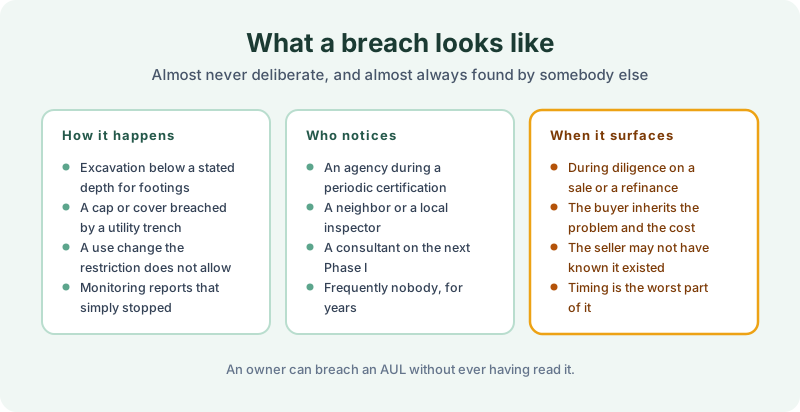
How it happens is mundane. Excavation below a stated depth for footings or a foundation. A cap or engineered cover breached by a utility trench. A change of use the restriction does not allow. Monitoring and reporting obligations that simply stopped being performed, which is by some distance the most common breach of all.
Who notices is the interesting part. An agency may catch it during a periodic certification cycle, if the state runs one. A neighbor or a local inspector occasionally does. A consultant preparing the next Phase I will see it. And frequently nobody notices for years, because there is no routine inspection and nothing about an unperformed obligation announces itself.
So the breach is usually discovered during diligence on a sale or a refinance, which is the worst possible timing. The buyer inherits the problem and the cost, the seller may genuinely not have known the restriction existed, and the discovery lands at a point where the transaction is already committed.
What follows a breach
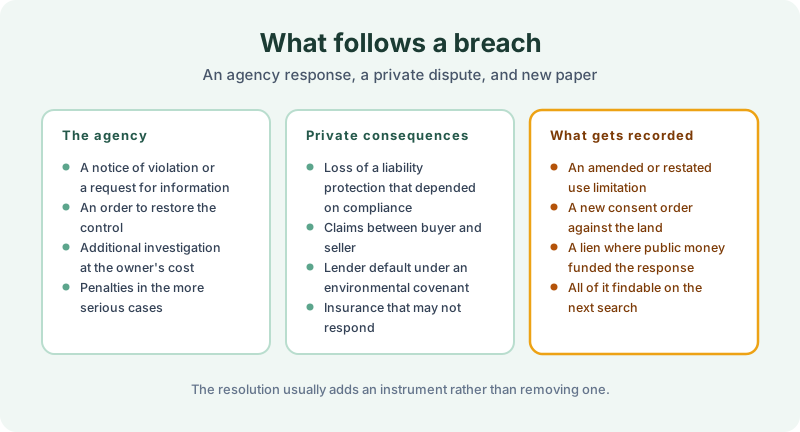
The agency response varies with the state and with the severity. A notice of violation or a request for information. An order to restore the control. Additional investigation at the owner’s cost, which is frequently the expensive part. Penalties in the more serious cases.
The private consequences can matter more. A liability protection that depended on compliance may be lost, which is the risk described in BFPP continuing obligations after closing. Claims arise between buyer and seller. A lender may call a default under an environmental covenant in the loan documents. Insurance may decline to respond to a condition the policy excluded.
What gets recorded is worth anticipating. Resolution usually adds an instrument rather than removing one, which is counterintuitive. An amended or restated use limitation, a new consent order against the land, or a lien where public money funded the response. All of it is findable on the next search, and all of it is part of the property’s permanent record.
Why termination is not the answer people hope for
An owner who discovers a restriction frequently asks whether it can simply be removed. Sometimes it can, and the process is slower and more documented than anybody expects, because the agency has to be satisfied that the condition the restriction addressed no longer requires it. That route is set out in terminating or modifying an AUL in the record.
A breach makes that harder rather than easier, since an agency considering termination will look at the compliance history first. Fixing the breach and restoring the control is almost always the faster path, and it is the one that preserves whatever protections depended on compliance.
Checking before you buy
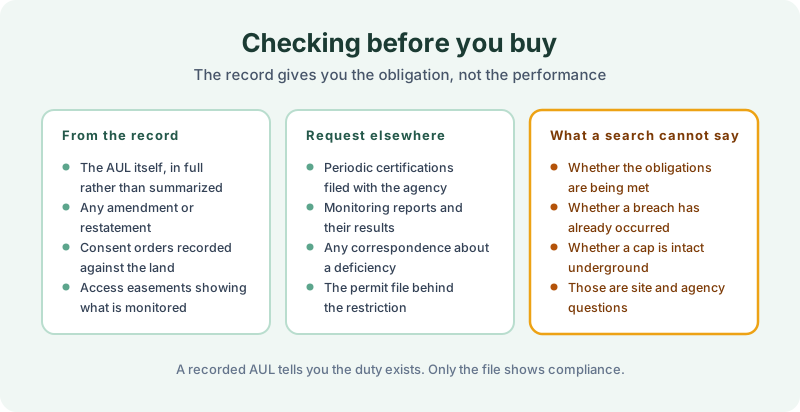
From the record you get the AUL itself in full rather than summarized, any amendment or restatement, consent orders recorded against the land, and the access easements that show what is actually being monitored.
Request from the agency the periodic certifications, the monitoring reports and their results, any correspondence about a deficiency, and the permit file behind the restriction.
What a search cannot say is whether the obligations are being met, whether a breach has already occurred, or whether a cap is intact underground. Those are site and agency questions. A recorded AUL establishes that the duty exists, and only the file shows performance.
The takeaway
Breaches are accidental, invisible and expensive, and they are usually found by the next buyer rather than by the owner who caused them. Read the instrument in full before anybody digs, and pull the compliance file alongside the search rather than after it.
The 1980 Environmental Lien & AUL report is how the recorded side gets documented. Certified title abstractors review land title and judicial records from 1980 to the present and document every environmental lien, encumbrance, and AUL found, with the recorded instruments attached. It’s $425, delivered by email in 3–5 business days. Order online, or see a sample report first.
Get an E1527-21 compliant lien & AUL report
Our 1980 Environmental Lien & AUL reports are researched by certified title abstractors, cover judicial records, and are guaranteed accurate. Delivered in 3–5 business days.
or call 877-848-5337