Published
The phrase environmental professional sounds like a job description and is actually a federal definition. It appears in the all appropriate inquiries rule, it decides who may direct a Phase I Environmental Site Assessment, and it is the reason a report carries a signed declaration rather than only a letterhead. Buyers who read that declaration carefully tend to read the rest of the report more carefully too, in the same way that reading the all appropriate inquiries rule changes how a closing checklist gets filled in.
Where the definition comes from
It sits in the federal regulation at 40 CFR 312.10, inside the rule that establishes what a buyer has to do to claim the landowner liability protections. The definition is about education, licensure and experience, in several permitted combinations, and EPA has published guidance explaining it because the combinations are easy to misread. Two points frame everything else. The definition does not preempt a state licensing law, so somebody who satisfies the federal test may still need a state credential to practice. And the requirement attaches to the person directing the inquiry rather than to every person who contributes to it, which is why a report can be assembled by a team and still rest on one signature.
The routes to qualifying
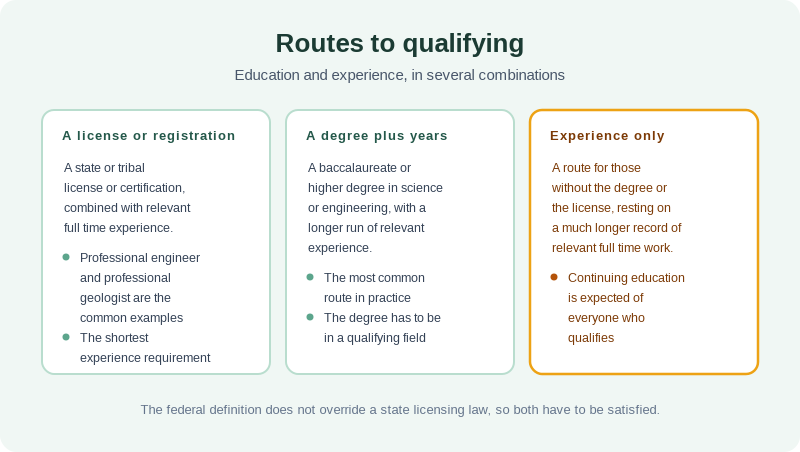
A state or tribal license or certification combined with relevant full time experience is the shortest path, and professional engineer and professional geologist registrations are the familiar examples. A baccalaureate or higher degree in a relevant science or engineering field with a longer run of relevant full time experience is the most common route in practice, and the field of the degree matters rather than the degree alone. There is also an experience only route for somebody with neither, resting on a substantially longer record of relevant full time work. Continuing education or comparable activity is expected of everyone who qualifies, so the status is maintained rather than permanent. The specific year counts are set by the regulation and are worth reading there rather than taken from any summary, this one included.
What the professional signs for
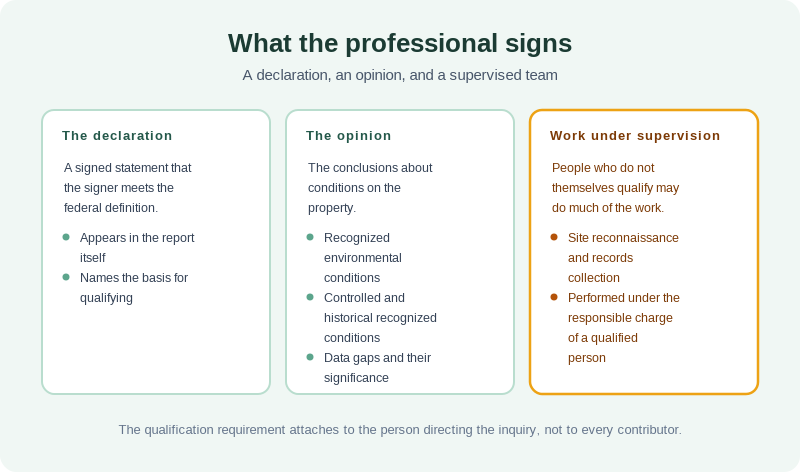
Three things arrive with the signature. A declaration stating that the signer meets the federal definition and naming the basis for it. An opinion on conditions, meaning the recognized environmental conditions, any controlled or historical recognized conditions, and the data gaps together with their significance, which is the subject of REC, CREC and HREC in a Phase I ESA. And a boundary around the supervised work, because site reconnaissance, interviews and records collection may be performed by people who do not themselves qualify, provided they work under the responsible charge of somebody who does. That arrangement is normal and is not a shortcut. What it does mean is that the person who walked the site may not be the person who signed the opinion about it, and a buyer who wants to ask questions about something observed on the ground should ask who made the observation.
What the user still owes
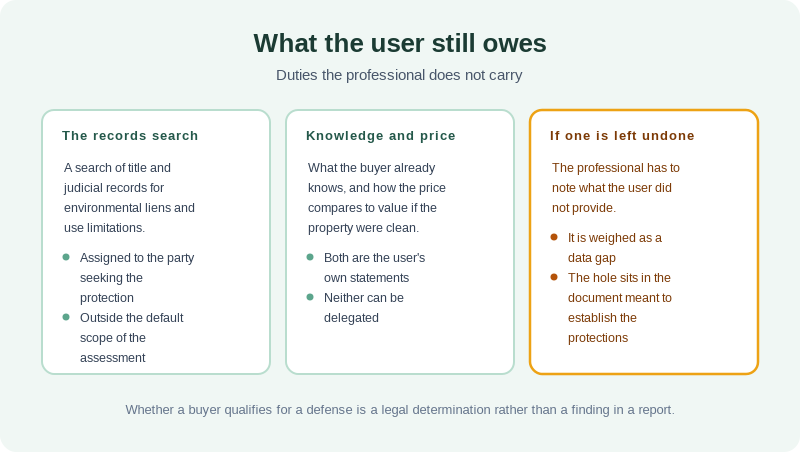
The rule splits the work, and the half it assigns to the buyer does not move to the professional by hiring one. The title and judicial records search for environmental liens and activity and use limitations is assigned to the party seeking the protection and sits outside the default scope of the assessment. So are the buyer’s own specialized knowledge and the price comparison against what the property would be worth unaffected, neither of which anybody else can supply. Leave one undone and the professional has to note it, weigh it as a data gap, and leave the hole sitting in the document meant to establish the protections. Our note on user responsibilities in a Phase I ESA walks through each item, and data gaps in an environmental lien search covers how a gap is reported.
Why a buyer should care about any of this
It is tempting to treat the declaration as boilerplate, and most of the time it is accurate and nothing turns on it. The cases where it matters are the ones where a report is later relied on by somebody who was not the original user, which happens constantly as properties change hands and lenders are replaced. A report whose signer did not meet the definition is a weak foundation for a protection, and that question gets asked years later rather than at closing. The same logic applies to the shelf life of a Phase I, where a report that was good when written stops being current on a schedule.
The takeaway
Read the declaration, confirm the basis named in it, and remember that the qualification covers the person directing the inquiry rather than the whole firm. Then look at your own side of the split, because that is where most files are thin. The 1980 Environmental Lien & AUL report handles the records half, where certified title abstractors review land title and judicial records from 1980 to the present and document every environmental lien, encumbrance, and AUL found, with the recorded instruments attached. It’s $425, delivered by email in 3–5 business days. Order online, check the FAQ, or hand the report to your environmental professional for the Phase I file.
Get an E1527-21 compliant lien & AUL report
Our 1980 Environmental Lien & AUL reports are researched by certified title abstractors, cover judicial records, and are guaranteed accurate. Delivered in 3–5 business days.
or call 877-848-5337