
Published
An industrial park warehouse built in 1968 has had six tenants. One of them, between 1979 and 1994, was a chemical distributor supplying solvents and cleaning products to manufacturers across three counties. Nothing was made on the site. Drums came in by truck and rail, were stored, were repackaged into smaller containers, and went out again. That is a materially different risk profile from a manufacturing site, and it is harder to research rather than easier. It sits close to a former drum reconditioning facility without the process.
What a chemical warehouse leaves
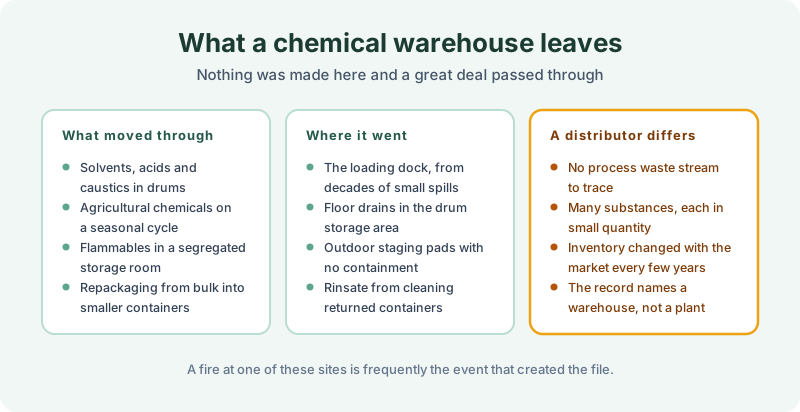
What moved through is whatever the market wanted. Solvents, acids and caustics in drums. Agricultural chemicals on a seasonal cycle, where the distributor served farms. Flammables in a segregated room. And on many sites, repackaging operations breaking bulk into smaller containers, which is the activity most likely to spill.
Where it went is predictable. The loading dock absorbs decades of small spills nobody reported. Floor drains in the drum storage area took whatever was hosed toward them. Outdoor staging pads frequently had no containment. And rinsate from cleaning returned containers went somewhere, usually a drain.
A distributor differs from a plant in ways that matter to the research. There is no process waste stream to trace, because there was no process. There were many substances in small quantities rather than a few in bulk, so the contamination signature is mixed. The inventory changed every few years with the market. And the land record simply names a warehouse, with nothing to indicate what was inside it.
Reading a distribution site
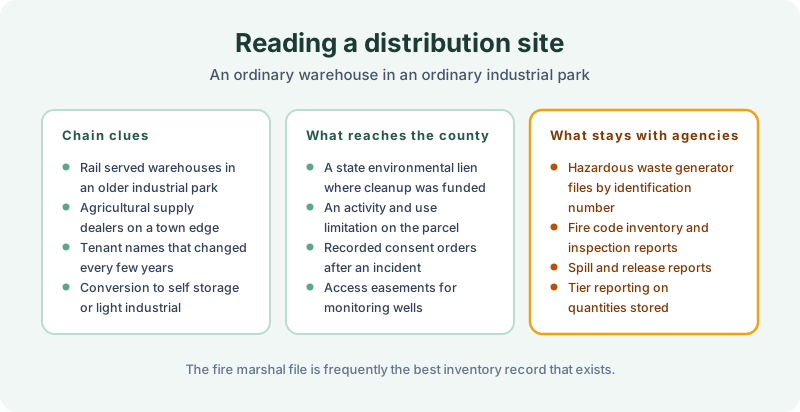
The chain clues are weak by the standards of this work. Rail served warehouses in an older industrial park. Agricultural supply dealers on the edge of a farming town, which is the pattern in a former agricultural chemical dealer. Tenant names that changed every few years. Conversion to self storage or light industrial once the original use ended.
What reaches the county is the usual set. A state environmental lien where public money funded work. An activity and use limitation. A recorded consent order after an incident. Access easements for monitoring wells.
What stays with the agencies is the part that would actually tell you something. Hazardous waste generator files indexed by an identification number belonging to a tenant who dissolved in 1996. Fire code inventory and inspection reports, which on these sites are frequently the best surviving record of what was stored. Spill and release reports. Tier reporting on quantities held. None of it is recorded, which is the standing limitation in data gaps in an environmental lien search.
Why the fire file matters more than usual
Because fire code enforcement required an inventory, and environmental regulation largely did not.
A distributor storing flammables above threshold quantities had to tell the fire marshal what was in the building, where, and how much. Those records are local, they are frequently retained, and they describe the inventory year by year in a way no environmental file does. On a site where the tenant is long gone and the generator file is thin, the fire marshal’s cabinet is the inventory history.
It also explains why so many of these sites have files at all. A fire at a chemical warehouse produces an incident response, runoff into a storm drain, and an agency file that would never have existed otherwise.
Scoping the search
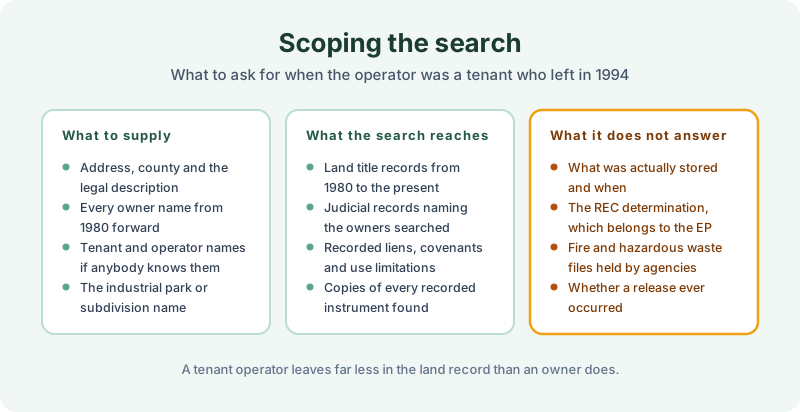
Give us the address, the county and the legal description, every owner name from 1980 forward, the tenant and operator names if anybody knows them, and the industrial park or subdivision name.
What comes back is the land title and judicial record picture from 1980 to the present, with copies of every recorded instrument located. What it does not answer is what was actually stored and when, the REC determination, which belongs to the environmental professional under ASTM E1527-21, or whether a release ever occurred.
The takeaway
A chemical distributor is an invisible industrial use in an ordinary building, operated by a tenant who left no mark on the chain. Order the lien and AUL search for the recorded picture, and ask the fire marshal for the inventory history, because that file answers the question the land record cannot.
The 1980 Environmental Lien & AUL report documents the recorded side. Certified title abstractors review land title and judicial records from 1980 to the present and document every environmental lien, encumbrance, and AUL found, with the recorded instruments attached. It’s $425, delivered by email in 3–5 business days. Order online, or read the FAQ if you want the scope set out first.
Get an E1527-21 compliant lien & AUL report
Our 1980 Environmental Lien & AUL reports are researched by certified title abstractors, cover judicial records, and are guaranteed accurate. Delivered in 3–5 business days.
or call 877-848-5337