
Published
Hospital closures and consolidations put a steady supply of these properties on the market, and they are appealing. Large buildings on large parcels, usually well located, often zoned generously, frequently available below replacement cost.
They are also industrial sites in the environmental sense, which is not how most buyers read them. A regional hospital ran a boiler plant, a laboratory, an imaging department, standby generators and in many cases its own incinerator, for fifty or sixty years. A medical laboratory on its own is smaller and chemically narrower, and it carries several of the same issues at a lower volume.
What the use leaves behind
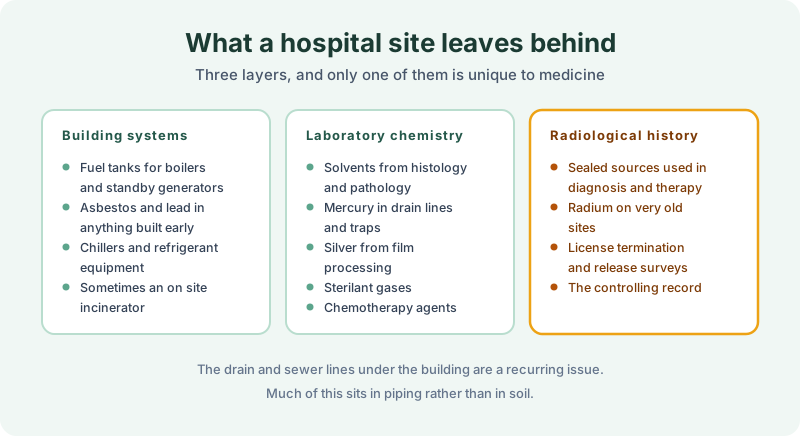
The building systems are the ordinary part. Fuel storage for boilers and standby generators, asbestos and lead in anything built before the relevant bans, refrigerant equipment, and on older campuses an on site incinerator for pathological and general waste.
The chemistry is more specific. Histology and pathology ran on solvents in quantity. Imaging departments processed film with silver bearing solutions for decades. Sterilizers used gases that are now tightly regulated. Pharmacies handled cytotoxic agents. And mercury was everywhere, in instruments and in laboratory drains, which is why the sanitary piping under an old hospital is a recurring finding rather than an unusual one.
That piping point is worth emphasizing. On these sites a meaningful share of what remains sits inside the building’s drain lines and in the soil immediately around them, rather than across the yard the way an industrial site would present.
The radiological file
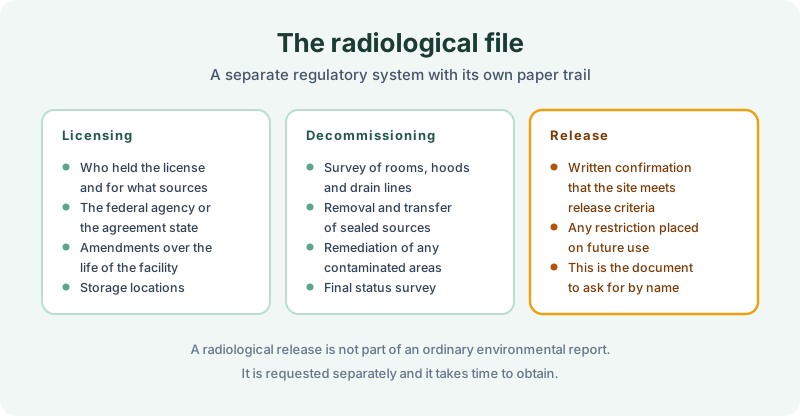
Radioactive materials in medicine are licensed by a separate regulator, either federal or a state operating under an agreement, and that system has its own records that no environmental report covers by default.
What matters to a buyer is the end of it. When a facility surrenders its license, the regulator requires a decommissioning process and a final status survey demonstrating that the site meets release criteria. Written confirmation of that release is the document to ask for by name, along with any restriction placed on future use of specific rooms or areas.
Older sites carry an extra question. Radium was used in therapy well into the twentieth century, handled under practices that would not be accepted now, and radium contamination in a building or in soil behind it has been found at a number of former medical properties long after everyone assumed the matter was closed.
What the recorded search covers
The lien and use limitation search covers the recorded layer, which here is the same layer as anywhere else. Environmental liens filed after a state cleanup, activity and use limitations, environmental covenants recorded under a state act, and any easement granted for monitoring access. The mechanics are those in how an environmental lien and AUL search is performed.
Where a use limitation does exist on a medical property it is often narrow in an unhelpful way, restricting a particular area or prohibiting a particular use rather than describing the whole condition. Reading one properly is the exercise in what an AUL actually requires.
Nothing about the radiological licensing reaches the county record, and neither does the air permit history or the sewer discharge file. A clean recorded result on a former hospital is a narrow finding, in the way data gaps in an environmental lien search describes.
Why these sites sit vacant
The gap between what a closed hospital is worth as a building and what it costs to convert one is the reason so many of them stand empty for a decade.
Conversion work is invasive. Turning patient floors into apartments means opening walls, replacing plumbing stacks and stripping the interior to structure, and each of those touches the materials described above. A buyer who priced the deal on the shell finds the abatement budget competing with the construction budget.
Public ownership is a common endpoint. Municipalities take these properties on, enter a state voluntary cleanup program, and accept a recorded use limitation as the price of closure. That route is the subject of voluntary cleanup programs, what gets recorded, and it is why the recorded layer on a long vacant campus is sometimes richer than on a site still running.
Scoping the search
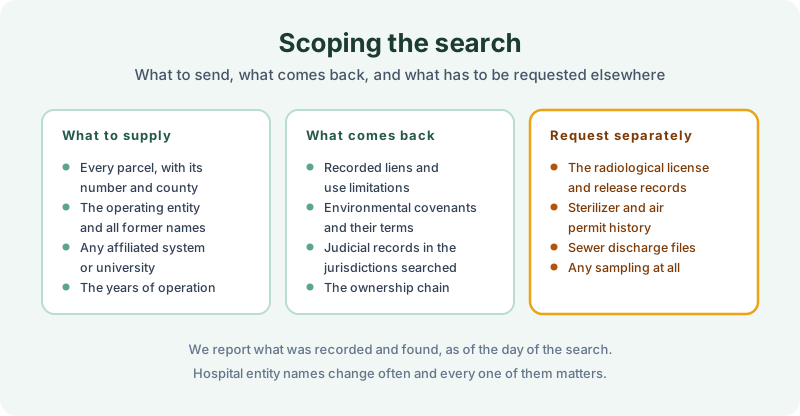
Give us every parcel with its number and county, the operating entity with all former names, any affiliated system or university, and the years of operation. Entity names are the difficulty on these properties, because hospitals merge, rename and reorganize repeatedly, and a lien indexed against a name that stopped being used in 1988 is still a lien.
Request the radiological records separately and start that early, because they come from a different agency on a different timetable than anything in environmental due diligence timeline assumes.
The takeaway
A former hospital is an industrial property with a civic exterior. The recorded search is quick and narrow, the radiological release is the document that governs reuse, and the drain lines are where a surprising amount of the problem lives.
Order a search, see what the 1980 search covers, or read the FAQ.
Get an E1527-21 compliant lien & AUL report
Our 1980 Environmental Lien & AUL reports are researched by certified title abstractors, cover judicial records, and are guaranteed accurate. Delivered in 3–5 business days.
or call 877-848-5337