
Published
Redevelopment on a closed military base is now an ordinary commercial transaction. Business parks, distribution centers, campuses, and housing all sit on land that the federal government transferred to a local authority, which then sold it on. What travels with that land is a set of recorded terms written years before your buyer appeared, and they are frequently more restrictive than anything a private seller would have imposed. The diligence question resembles brownfield redevelopment, with a federal grantor at the top of the chain.
How base land becomes private
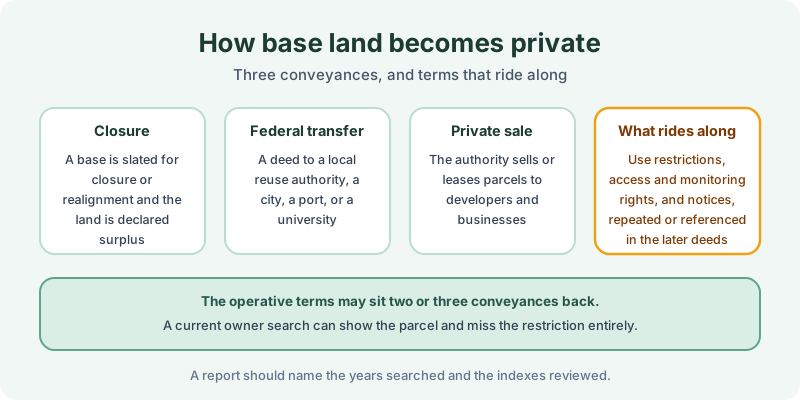
The sequence is consistent. A base is slated for closure or realignment and the land is declared surplus. The government conveys or leases it to a local reuse authority, a city, a port district, or a university, sometimes in phases as environmental work is completed. That entity then plats and sells parcels to developers and businesses.
Each of those conveyances can carry terms forward, either by repeating them or by referencing the earlier instrument. That is the structural point for a search: the operative restriction may sit two or three conveyances back, and a search that reaches only the most recent sale can report the parcel accurately while missing the document that governs what may be built on it.
Two variations show up often enough to plan for. Some parcels were leased before they were deeded, under a lease in furtherance of conveyance or a long term enhanced use lease, and the recorded memorandum of that lease may carry the restrictions that the later deed simply incorporates by reference. And transfers were frequently phased parcel by parcel as environmental work finished, so two adjoining lots inside the same former base can carry completely different terms depending on which year each one was released.
What actually gets recorded
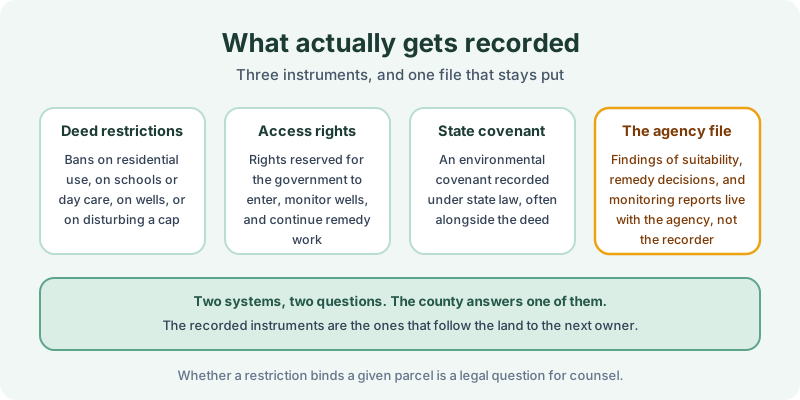
Deed restrictions are the common form. Prohibitions on residential use, on schools or child care, on groundwater wells, on excavation below a stated depth, or on disturbing an engineered cap. Access and monitoring rights are usually reserved alongside them, letting the government enter to sample wells, maintain a remedy, or complete work that was not finished at transfer. State environmental covenants are frequently recorded in parallel under state law, which is the mechanism our note on institutional control registries describes.
What does not reach the recorder is the agency file. Findings of suitability to transfer or lease, remedy decision documents, monitoring reports, and five year reviews all live with the agency rather than in the county index. Those are the consultant’s territory, and the split is the same one covered in what an AUL actually requires. The recorded instruments are the ones that follow the land to the next owner, and they are the ones a lien and AUL search is designed to find.
It is also worth knowing that restrictions on these sites are not uniformly environmental. Deeds out of a reuse authority commonly add development obligations, reverter or right of reentry language if a use is abandoned, airfield height limits where a runway is still in service, and historic preservation covenants on older buildings. All of those are recorded instruments, all of them survive a resale, and all of them belong in the same review as the cleanup restrictions.
Scoping the search
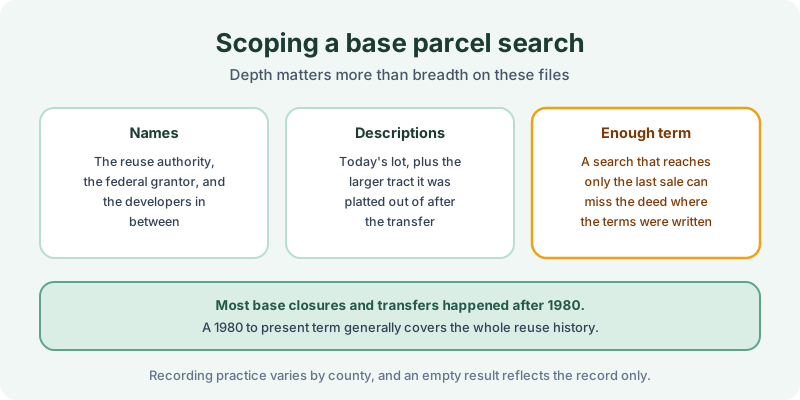
Send names as well as the parcel. The reuse authority, the federal grantor, and the developers in between are the search terms that reach the instruments where the restrictions were written. Send today’s lot description and, where you have it, the larger tract it was platted out of, because a restriction recorded against the whole transfer parcel may be indexed under a description that no longer matches your lot.
Depth is the variable that decides whether this search works. Most closures and transfers happened after 1980, so a 1980 to present term generally covers the entire reuse history, which is the reason for the 1980 date in the first place. A short current owner search is the wrong tool here.
Two cautions on reading the result. A restriction found of record is a fact about a document; whether it binds this parcel, and what it permits, is a legal question for counsel rather than a records conclusion. And an empty result reflects the indexes searched over the term searched, not the condition of the land. Recording practice varies by county, and federal transfer documents are recorded inconsistently from one jurisdiction to another.
Our 1980 Environmental Lien & AUL report covers both halves of this: certified title abstractors review land title and judicial records from 1980 to the present and document every environmental lien, encumbrance, and AUL found, with the recorded instruments attached. It’s $425, delivered by email in 3–5 business days. Order online, or review a sample report to see the format your file will receive.
Get an E1527-21 compliant lien & AUL report
Our 1980 Environmental Lien & AUL reports are researched by certified title abstractors, cover judicial records, and are guaranteed accurate. Delivered in 3–5 business days.
or call 877-848-5337