Published
Thousands of American cities burned their household waste on site, in municipal incinerators that ran from the 1920s until federal air rules closed most of them between the 1960s and the 1980s. The buildings came down, the stacks came down, and the land usually became a park, a public works yard or a transfer station. What stayed is the ash, and a parcel carrying graded ash fill reads as perfectly ordinary ground from the surface. The archetype sits beside a former landfill disposal site, and the two are frequently the same parcel.
What the operation left
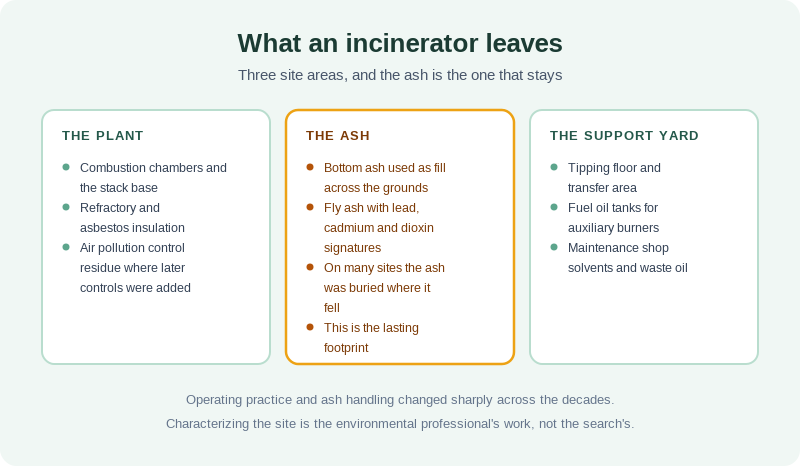
The plant itself contributed refractory brick, asbestos insulation and, on units retrofitted late in life, air pollution control residue. The support yard added a tipping floor, fuel oil tanks for the auxiliary burners and a maintenance shop with the usual solvents and waste oil.
The ash is the part that stays. Bottom ash was routinely used as fill across the grounds and sometimes well beyond them, and fly ash from the later control equipment carries lead, cadmium and dioxin signatures. On a great many sites the ash was simply buried where it fell, because that was accepted practice for decades. Operating practice changed sharply across the twentieth century, and characterizing any particular site is the environmental professional’s work rather than the records searcher’s.
Why this archetype gets missed
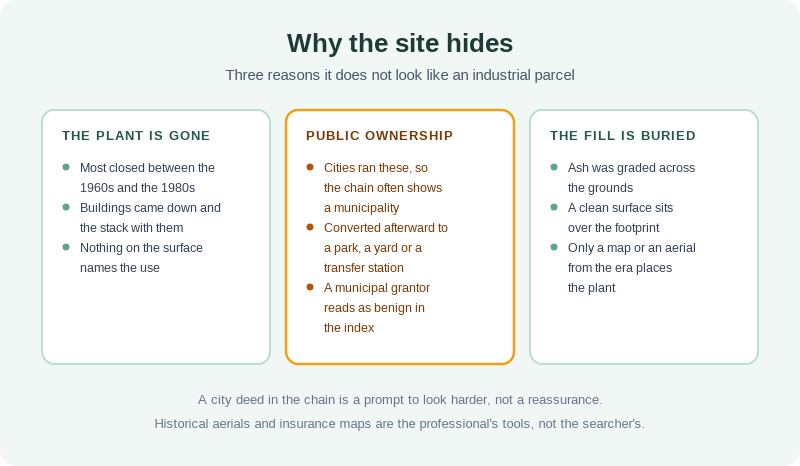
Three things conspire. The plant is gone, so nothing on the surface names the use. The ash is buried under clean grade, so nothing on the surface suggests it. And the chain of title shows a municipal grantor, which most reviewers read as reassuring rather than as a prompt.
That third point is the one worth sitting with. A city or county in the chain is not evidence that a parcel was a park. Cities owned the incinerators, the dumps, the gas works and the public works yards, and a deed out of a municipality is a reason to look harder at what the land was used for before the transfer, not a reason to relax. Placing the plant takes historical aerials and insurance maps, which are the professional’s tools, and they sit well outside the land record.
What the record can carry
A transfer out of public ownership is where the recorded instruments usually appear. When a city sells or leases a former plant site, the deed frequently carries restrictions on reuse, limits on excavation, or a requirement that a cap be maintained. Those run with the land. Alongside them you may find recorded cost recovery liens, activity and use limitations over the ash fill areas, and easements letting an agency reach monitoring wells.
Municipal abatement and demolition liens appear on sites where the structure came down under an order. What an AUL actually obliges an owner to do is set out in what an AUL actually requires, and the priority question on cost recovery liens is covered in environmental superlien states.
What the search reads
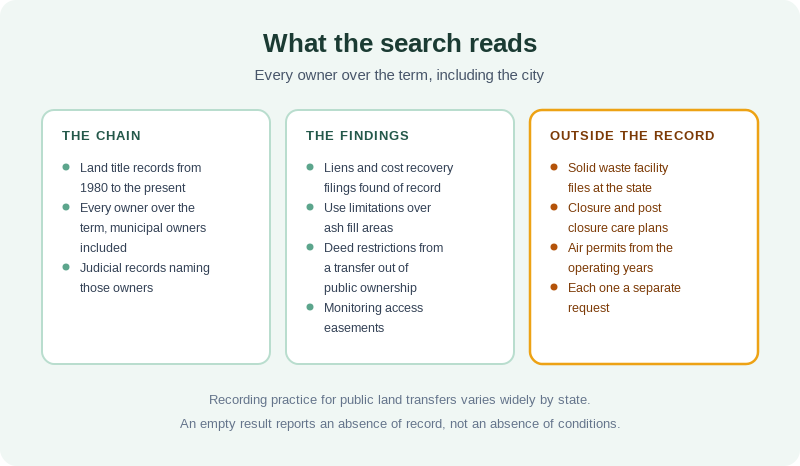
The search reads land title records from 1980 to the present and judicial records naming the owners, covering every owner over the term including municipal ones. It returns the liens, use limitations, deed restrictions and access easements found of record, with copies of the instruments.
Solid waste facility files, closure and post closure care plans, and air permits from the operating years sit outside the land record, each a separate request to the agency that holds it. Recording practice for public land transfers varies widely by state, so an empty result reports an absence of record rather than an absence of conditions. Whether a finding amounts to a recognized environmental condition is the environmental professional’s call. The FAQ covers what the report does and does not include, and a sample report shows the format.
The takeaway
Treat a municipality in the chain as a question rather than an answer, search the full term rather than the current owner, and ask specifically about restrictions attached to the transfer out of public ownership, because that deed is where the obligations usually sit. Ash fill does not announce itself, and neither does a covenant recorded thirty years ago against a parcel that is now a soccer field.
Our 1980 Environmental Lien & AUL report is where that research lands. Certified title abstractors review land title and judicial records from 1980 to the present and document every environmental lien, encumbrance, and AUL found, with the recorded instruments attached. It’s $425, delivered by email in 3–5 business days. Order online, or read tax foreclosed parcel environmental lien search for the other common route a parcel ends up in public hands.
Get an E1527-21 compliant lien & AUL report
Our 1980 Environmental Lien & AUL reports are researched by certified title abstractors, cover judicial records, and are guaranteed accurate. Delivered in 3–5 business days.
or call 877-848-5337