
Published
A manufacturer sells its plant to an investment fund and leases it back for twenty years. Nothing about the operation changes. The same equipment runs the same processes with the same people, and the only thing that moved is the deed. That makes the transaction feel like a financing rather than a real estate deal, which is exactly how the environmental question gets skipped. The operating history stayed on the land, and so did anything recorded against it. This is a close relative of an environmental lien search for leased property, with the roles inverted.
What a sale leaseback changes
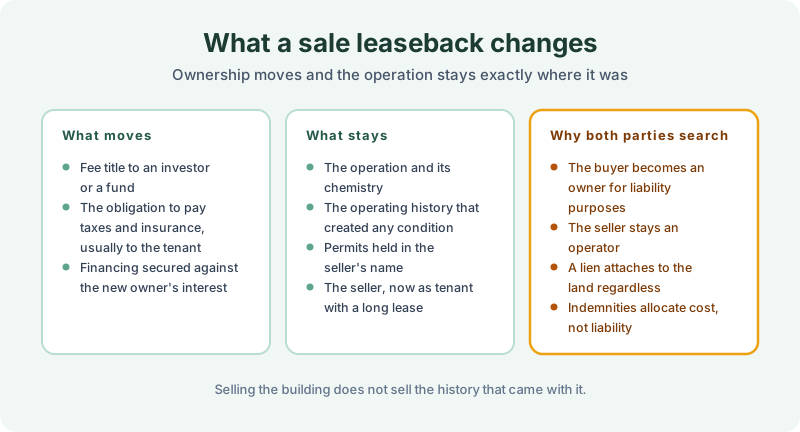
What moves is fee title to an investor or a fund, the obligation to pay taxes and insurance which usually shifts to the tenant under a net lease, and financing secured against the new owner’s interest.
What stays is everything that matters environmentally. The operation and its chemistry. The operating history that created whatever condition exists. Permits held in the seller’s name and the agency relationships behind them. And the seller itself, now sitting on the property as a tenant with two decades to run.
Both parties need the search, and for different reasons. The buyer becomes an owner, which is a liability category under CERCLA and most state statutes regardless of who operates the site. The seller stays an operator, which is the other category. A recorded lien attaches to the land whoever holds it, and the indemnity the parties negotiate allocates the cost between them rather than changing who is liable to a regulator.
Who carries what afterwards
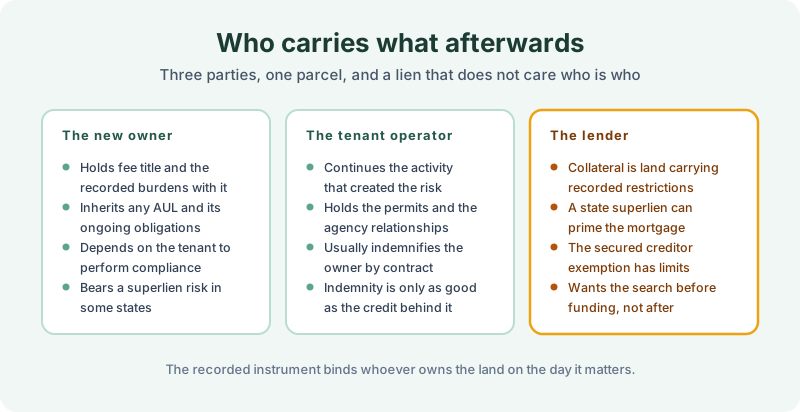
The new owner holds fee title and every recorded burden with it, inherits any activity and use limitation along with its ongoing monitoring and reporting duties, and depends on the tenant to actually perform that compliance. In the superlien states the owner also carries a priority risk described in environmental superlien states.
The tenant operator continues the activity, holds the permits, and usually indemnifies the owner by contract. That indemnity is worth exactly what the credit behind it is worth, over a twenty year term, which is a longer horizon than most covenant packages are built for.
The lender financing the purchase has collateral that is land carrying recorded restrictions, faces the same superlien exposure, and finds that the secured creditor exemption is narrower than it sounds if it ever has to take the property. That analysis is set out in environmental liens for lenders.
Why the diligence gets skipped
Because the transaction is presented as a financing. The seller knows the site, the buyer is underwriting a lease and a credit rather than a property, and nobody in the room is the person who normally asks about tanks.
There is also a structural problem with relying on the seller’s knowledge. The seller has the most complete picture of the site and the least incentive to volunteer it, and a buyer who accepts a representation in place of an inquiry has not performed appropriate inquiry in the statutory sense. The protections in all appropriate inquiries are only available to a party who actually made the inquiry.
What a finding does to the deal
A recorded lien or use limitation discovered during diligence changes three things at once, and it is worth knowing which lever each party will reach for.
Price. The simplest response, and the one available only before signing. An amount of known exposure comes off the purchase price and the matter is closed.
Rent. On a net lease the tenant already bears most operating costs, so a finding can be absorbed by allocating monitoring and compliance obligations explicitly rather than leaving them to the default language. This is the cheapest fix when the obligation is ongoing rather than one time.
Security. Where the exposure is unquantified, the parties reach for an escrow or a parent guarantee. Both are private arrangements that leave no trace in the land record.
Scoping the search
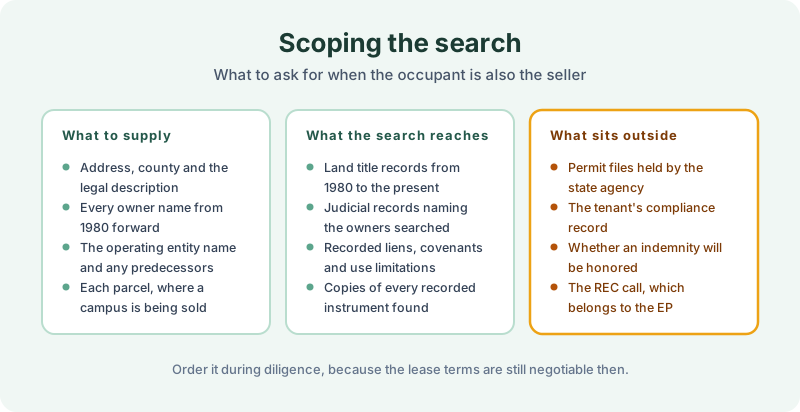
Give us the address, the county and the legal description, every owner name from 1980 forward, the operating entity name with any predecessors, and each parcel separately where a campus is being sold as a package.
What comes back is the land title and judicial record picture from 1980 to the present, with copies of every recorded instrument located. What sits outside is the permit file held by the state agency, the tenant’s compliance record, whether an indemnity will actually be honored, and the REC determination, which belongs to the environmental professional under ASTM E1527-21.
The takeaway
Selling a building does not sell the history that came with it, and a sale leaseback moves the ownership while leaving the operation exactly in place. Run the search during diligence, when the lease terms and the indemnity are still being negotiated, because afterwards the finding is somebody’s problem rather than everybody’s.
The 1980 Environmental Lien & AUL report is how that gets documented. Certified title abstractors review land title and judicial records from 1980 to the present and document every environmental lien, encumbrance, and AUL found, with the recorded instruments attached. It’s $425, delivered by email in 3–5 business days. Order online, or see a sample report first.
Get an E1527-21 compliant lien & AUL report
Our 1980 Environmental Lien & AUL reports are researched by certified title abstractors, cover judicial records, and are guaranteed accurate. Delivered in 3–5 business days.
or call 877-848-5337