
Published
Car dealerships turn over constantly and the buildings outlive the brands. A corner site that sold one make for thirty years becomes an independent used lot, then a tire chain, then a self storage building or a drugstore. Each of those transitions moves the parcel through a chain of title, and the thing worth knowing is that the environmental history belongs to the service bays rather than to the showroom. A dealership searches less like retail and more like the former auto body shop that often sat behind it.
Three systems under one roof
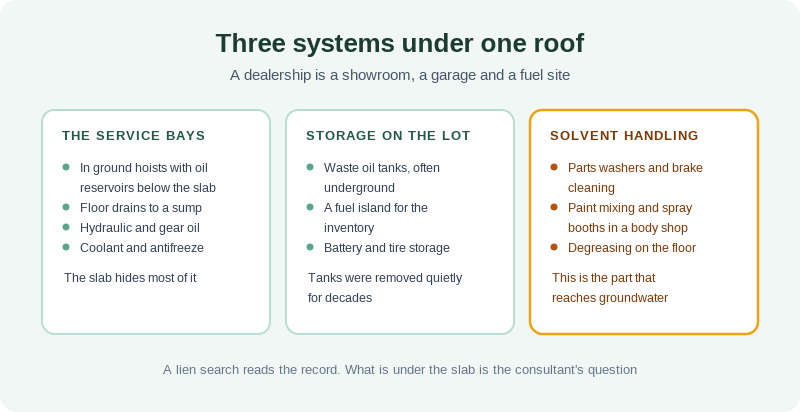
The showroom is a building. The service department is an industrial operation, and a full line franchise store ran a substantial one.
- In ground hoists. For most of the twentieth century a service bay lift sat in a cased hole with an oil reservoir below the slab. Removal was often informal, and the record of it, where one exists, sits with the state rather than the county.
- Floor drains and sumps. Wash bays and service bays drained somewhere, and on older sites that somewhere was a dry well or a septic field rather than a sewer.
- Waste oil and fuel. A used oil tank, frequently underground, plus a fuel island for moving inventory around the lot. Tank removals happened quietly for decades before registration was routine.
- Solvent. Parts washers, brake cleaning and, where there was a body shop, paint mixing and spray booths.
That last category is the one that reaches groundwater, and it is why a dealership is worth treating as a solvent site rather than only as a petroleum site.
Where the records actually sit
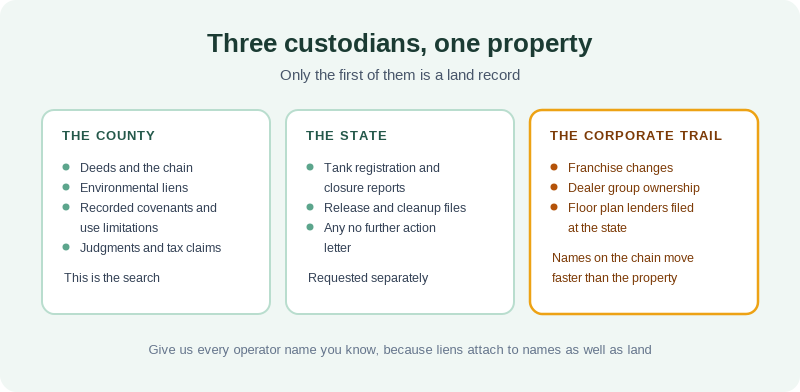
Three custodians hold three different things, and only one of them is a land record.
The county holds the chain, any environmental lien, recorded covenants and use limitations, judgments and tax claims. That is what a search reads, and where a recorded restriction would appear if one was imposed, in the form described in what is an activity and use limitation.
The state holds tank registrations, closure reports, release files and any no further action determination. Those are requested separately and they are frequently the richest source on a site like this.
The third is the corporate trail, and on dealerships it is unusually tangled. Franchises move between dealer groups, the real estate is often held by a separate entity from the operating store, and floor plan lenders file at the state. Liens attach to names as well as to land, so the operator history matters, which is the point made in how an environmental lien and AUL search is performed.
What a recorded restriction would look like here
Where a release was investigated and closed with contamination left in place, the closure frequently carries conditions, and in states that have adopted a uniform environmental covenants approach those conditions are recorded against the parcel. On a former dealership the usual ones are a restriction to commercial or industrial use, a prohibition on groundwater extraction, a requirement to maintain the slab or pavement as a cap, and a vapor mitigation obligation where a building stays in use.
Those are exactly the instruments a search is reading for, and the general shape is set out in environmental covenants and UECA. A redevelopment that proposes to break the slab for new footings is the case where one of them becomes expensive rather than theoretical.
Scoping the order
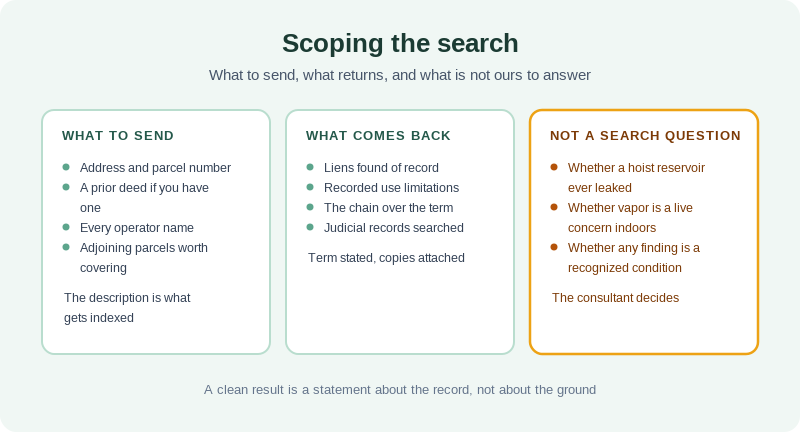
Send the address, the parcel number and a prior deed if you have one, since the legal description is what the recorder indexes against. Name every operator you know of, including the real estate holding entity if it differs from the store.
Flag adjoining parcels. Dealerships expanded by buying the lot next door, and the inventory overflow lot across the street is frequently part of the same operation and a separate parcel in the record. The reasoning is the same one in adjoining property searches.
Term length is the remaining decision. Many of these sites were built in the 1950s and 1960s and were busiest before 1980, so a window opening in 1980 catches the closure and the later uses while the earliest operating years sit above it. Whether that matters depends on what the file is for, and why 1980 is the search date covers the reasoning.
The takeaway
A records search reports what was found of record in the indexes reviewed over the term searched, and a clean result is a statement about the record rather than about the ground. Whether a hoist reservoir leaked, whether vapor is a live concern indoors, and whether any finding is a recognized environmental condition are judgments for the environmental professional. The 1980 Environmental Lien & AUL report is the product that covers this. Certified title abstractors review land title and judicial records from 1980 to the present and document every environmental lien, encumbrance, and AUL found, with the recorded instruments attached. It’s $425, delivered by email in 3 to 5 business days. Order online, or read the former gas station archetype if the fuel island is the part that concerns you.
Get an E1527-21 compliant lien & AUL report
Our 1980 Environmental Lien & AUL reports are researched by certified title abstractors, cover judicial records, and are guaranteed accurate. Delivered in 3–5 business days.
or call 877-848-5337