
Published
A small town creamery closed in 1988 and the building has been a furniture showroom since 1994. It presents as about the most benign industrial history available, and the processing floor itself probably is. What is worth finding is the lagoon at the back of the adjoining field, unlined, which took high strength wastewater for forty years and may well have been closed by the simple method of pushing earth into it. This is a water and nitrogen site rather than a solvent one, and it shares that character with a former cannery.
What a dairy leaves
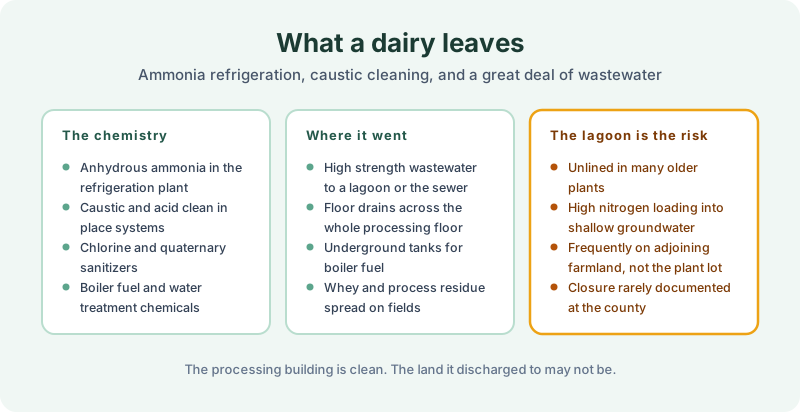
The chemistry is modest and continuous. Anhydrous ammonia in the refrigeration plant, in the same way as a cold storage warehouse. Caustic and acid in clean in place systems, circulated through the lines every day the plant ran. Chlorine and quaternary sanitizers. Boiler fuel and the water treatment chemicals that go with it.
Where it went is the question. High strength wastewater went to a lagoon or to a municipal sewer that may not have been built for it. Floor drains ran the length of the processing floor. Underground tanks held boiler fuel. And whey and process residue were frequently spread on nearby fields as a disposal method rather than as a fertilizer program.
The lagoon is the risk and it is usually off the plant parcel. Many were unlined, the nitrogen loading into shallow groundwater is substantial, and closure was rarely documented in any way that reached the county. A buyer searching the plant lot alone has searched the part that is probably fine.
Reading a dairy site
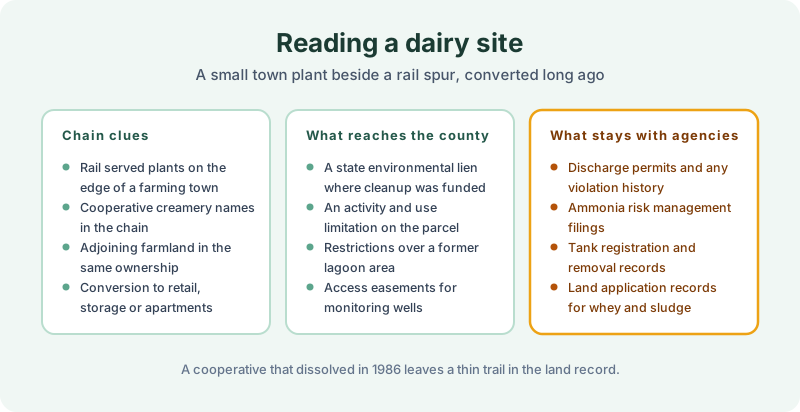
The chain gives decent signals. Rail served plants on the edge of a farming town. Cooperative creamery names appearing as grantor or grantee. Adjoining farmland held in the same ownership, which is where the land application happened. And conversion to retail, storage or apartments once the plant closed.
What reaches the county is the familiar set. A state environmental lien where public money funded work. An activity and use limitation. Restrictions over a former lagoon area. Access easements for monitoring wells.
What stays with the agencies is the operating history. Discharge permits and violations. Ammonia risk management filings. Tank registration and removal. Land application records for whey and sludge. A cooperative that dissolved in 1986 leaves very little behind in the land record, which is the standing limit in data gaps in an environmental lien search.
Why the adjoining parcels matter here
Because the discharge did not stay on the plant lot, and in many cases was never meant to.
Land application was a normal and permitted practice, the fields used were frequently owned by the cooperative or by its members rather than by the plant, and nothing about the plant’s chain names them. A search that covers only the parcel being bought will be accurate and will miss the ground that actually received the loading. That is the same situation described in adjoining property environmental lien searches.
The ammonia question, answered the same way as cold storage
Dairies ran industrial refrigeration, and the ammonia inventory on a mid sized plant was substantial enough to trigger federal risk management reporting.
The same correction applies here as on any refrigerated site. Ammonia is an acute air and safety hazard rather than a persistent soil contaminant, so a plant with a long ammonia compliance history and an incident or two in its file is not thereby a soil problem. The soil and groundwater exposure on a dairy is the wastewater, the boiler fuel tanks and whatever went down the floor drains, which is the same reading set out in former cold storage plants.
Asbestos on the pipe insulation is close to guaranteed on anything built before 1980, and that is a building materials question for the Phase I rather than a land record one.
Scoping the search
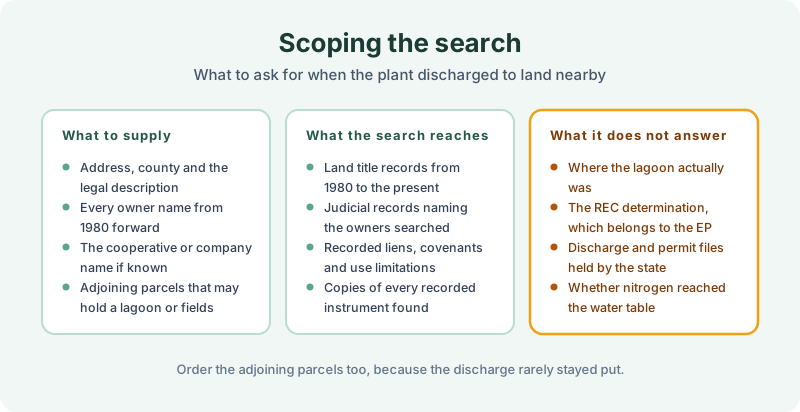
Give us the address, the county and the legal description, every owner name from 1980 forward, the cooperative or company name if anybody knows it, and the adjoining parcels that may hold a lagoon or the application fields.
What comes back is the land title and judicial record picture from 1980 to the present, with copies of every recorded instrument located. What it does not answer is where the lagoon actually was, the REC determination, which belongs to the environmental professional under ASTM E1527-21, or whether nitrogen reached the water table.
The takeaway
Dairies look like the safest industrial history there is, and the processing building usually is. The exposure sits in a lagoon and a set of fields that are frequently somebody else’s parcels, so search outward rather than only down.
The 1980 Environmental Lien & AUL report documents the recorded side. Certified title abstractors review land title and judicial records from 1980 to the present and document every environmental lien, encumbrance, and AUL found, with the recorded instruments attached. It’s $425, delivered by email in 3–5 business days. Order online, or read the FAQ if you want the scope set out first.
Get an E1527-21 compliant lien & AUL report
Our 1980 Environmental Lien & AUL reports are researched by certified title abstractors, cover judicial records, and are guaranteed accurate. Delivered in 3–5 business days.
or call 877-848-5337