
Published
A six-story brick warehouse near the old rail yard is being converted into apartments. It was an ice plant from 1922, then a cold storage warehouse until the late 1980s, then a self storage operation, and now it is a redevelopment site. The environmental question everybody asks first is about the ammonia, because that is what a refrigeration plant is famous for. It is also, for land record purposes, largely the wrong question. This is a fuel and solvent site wearing a refrigeration plant’s reputation, closer in character to a former bulk petroleum terminal than to a chemical works.
What a cold storage plant leaves
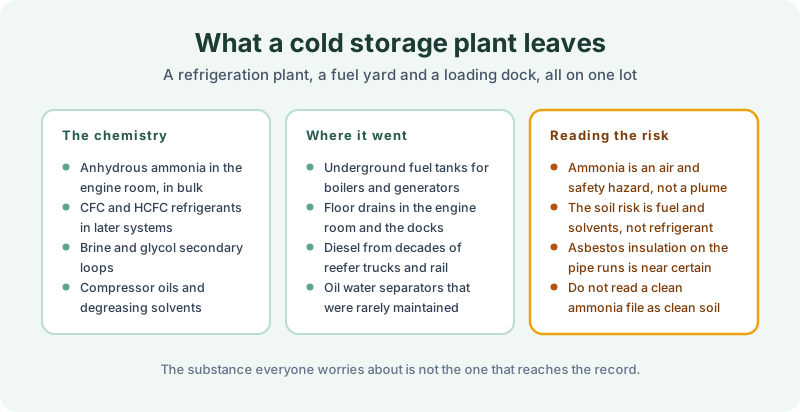
The chemistry is consistent across the building type. Anhydrous ammonia in bulk in the engine room, which is the industry standard refrigerant and remains so today. CFC and HCFC refrigerants in later or smaller systems. Brine and glycol in secondary loops. Compressor oils, and the solvents used to degrease machinery that ran continuously for decades.
Where it went matters more than what it was. Underground fuel tanks served boilers and standby generators, and on a plant of this age there were usually several. Floor drains in the engine room and on the loading docks took whatever was spilled. The truck and rail apron absorbed diesel from refrigerated trailers and reefer cars idling for hours at a time. Oil water separators were installed and, on most sites, maintained indifferently.
Reading the risk correctly is the whole point here. Ammonia is an acute air and safety hazard rather than a persistent soil contaminant, because it does not linger in the ground the way a chlorinated solvent does. The soil and groundwater risk on these sites is fuel and solvent, and asbestos pipe insulation on the refrigeration runs is close to guaranteed on anything built before 1980. A clean ammonia compliance file says nothing whatever about the soil.
Reading a cold store in the chain
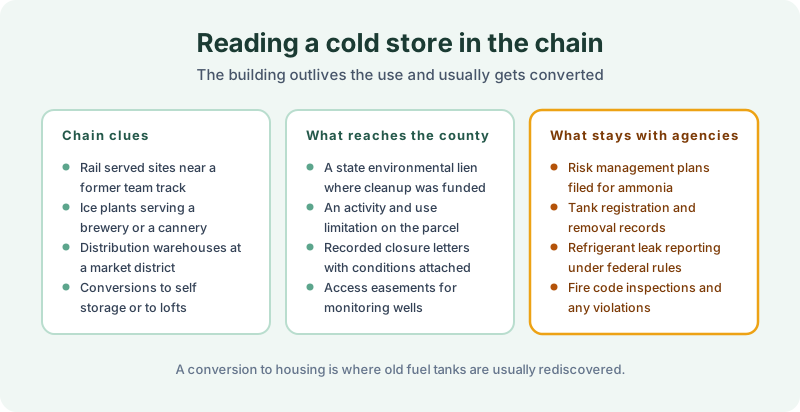
The chain rarely names the use directly, so you identify these buildings by their siting. Rail served parcels near a former team track. Ice plants adjoining a brewery, a dairy or a cannery, which is the pattern in a former cannery site. Distribution warehouses clustered at a market district. And most usefully, conversions, because the building is structurally excellent and gets reused as self storage, as lofts or as a data center.
What reaches the county is the standard set. A state environmental lien where public money funded work. An activity and use limitation restricting excavation or requiring a vapor barrier. A recorded closure letter with conditions attached. An access easement for monitoring wells.
What stays with the agencies is substantial. Risk management plans filed for threshold quantities of ammonia, tank registration and removal records, federal refrigerant leak reporting, and fire code inspection history. None of that is recorded against the land, which is the standing limitation set out in data gaps in an environmental lien search.
Why conversions are when this surfaces
Because the building sat there for thirty years doing no harm to anybody, and then somebody excavated for an elevator pit or a parking structure. Old fuel tanks are typically rediscovered during a conversion rather than during a sale, at the point when a construction schedule is already running.
That is an argument for ordering the lien and AUL search at the front of a redevelopment rather than at the closing, which is the same case made in environmental lien search for a construction loan. A finding that arrives while the drawings are still schematic costs a redesign. The same finding after the footings are set costs the schedule.
Scoping the search
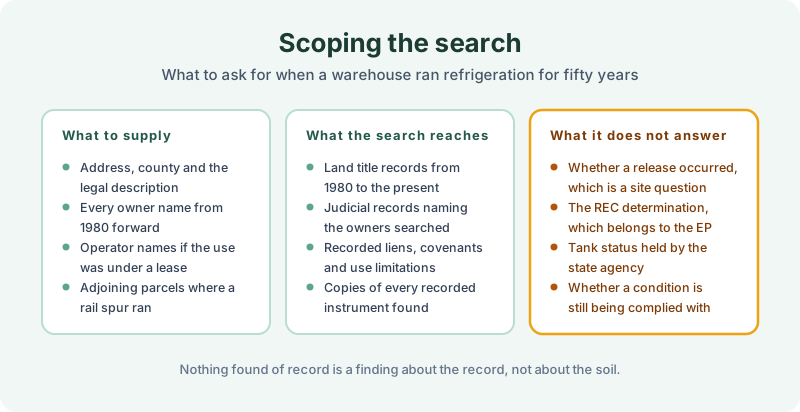
Give us the address, the county and the legal description, every owner name from 1980 forward, and the operator names where the use sat under a lease. Add the adjoining parcels where a rail spur ran, because the apron and the spur frequently sit on different ownership from the building.
What comes back is the land title and judicial record picture from 1980 to the present, with copies of every recorded instrument located. What it does not answer is whether a release occurred, which is a site question, or the REC determination, which belongs to the environmental professional under ASTM E1527-21.
The takeaway
Cold storage sites are misread in a specific and consistent way. The refrigerant gets the attention and the fuel tanks cause the problem, and the buildings get converted often enough that somebody is usually digging. Order the search early, and read the ammonia file and the tank file as two separate questions.
The 1980 Environmental Lien & AUL report documents the recorded side. Certified title abstractors review land title and judicial records from 1980 to the present and document every environmental lien, encumbrance, and AUL found, with the recorded instruments attached. It’s $425, delivered by email in 3–5 business days. Order online, or read the FAQ if you want the scope set out first.
Get an E1527-21 compliant lien & AUL report
Our 1980 Environmental Lien & AUL reports are researched by certified title abstractors, cover judicial records, and are guaranteed accurate. Delivered in 3–5 business days.
or call 877-848-5337