Published
A seller hands you a letter from the state environmental agency saying it has no present intention of pursuing a future owner, and the question lands immediately. Does that letter bind anyone, does it travel with the property, and will it show up in a title search. The short version is that these documents matter a great deal and almost never appear in the land record, which makes them easy to mistake for something they are not. They sit alongside the recorded instruments described in what gets recorded in a voluntary cleanup program rather than among them.
Two different documents
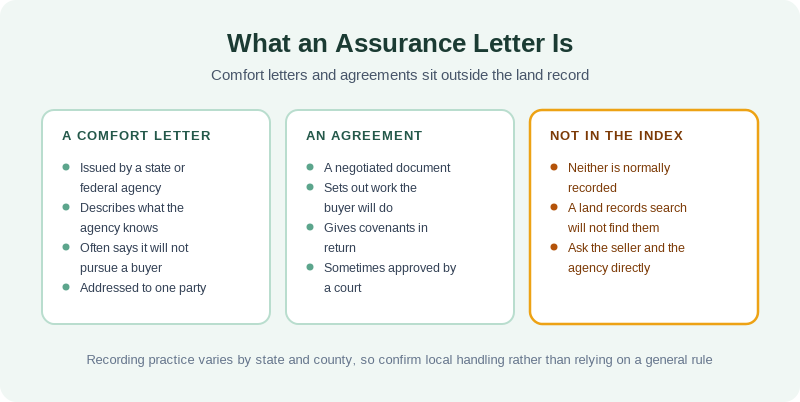
A comfort or status letter is issued by a federal or state agency and describes what the agency currently knows about a site. It often states that the agency does not plan to take enforcement action against a prospective purchaser on the facts presented. It is addressed to a specific party, it reflects a point in time, and it generally does not create rights that a later owner can rely on.
A prospective purchaser agreement is a negotiated instrument. The buyer commits to specified work or access, and the agency gives covenants not to sue or similar protections in return. In some jurisdictions these are approved by a court or published for comment. They are far stronger than a letter, and they are also far more specific about who benefits.
Both are worth having. Neither one is a substitute for an inquiry that supports a statutory defense, which is the point made in the all appropriate inquiries rule.
Why they are not recorded
Recording exists for interests that run with the land. An environmental covenant restricts what an owner may do with a parcel forever, so it belongs in the index where every future buyer will find it. A letter from an agency to a named purchaser binds a relationship, not a parcel, and there is usually nothing to record.
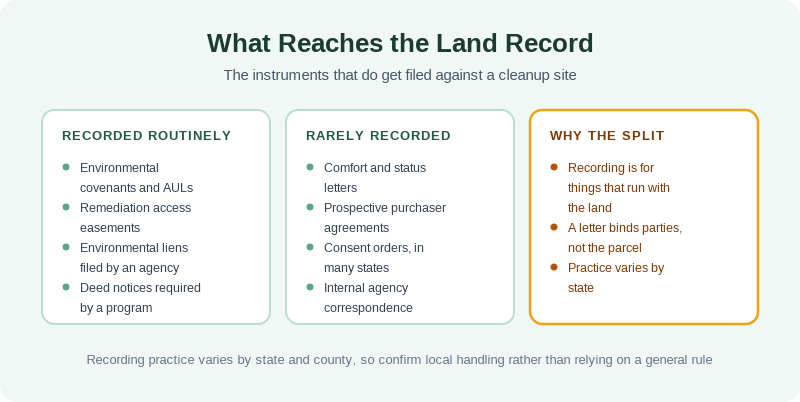
What does reach the record is a different list. Environmental covenants under UECA and other activity and use limitations are recorded routinely. So are remediation access easements, environmental liens filed by an agency, and deed notices a program requires. Each of those binds the land and is written to be found.
Practice does vary. A few states record consent orders or program completion documents, and a handful require notice of an agreement to be filed. That variation is exactly why a search is worth running rather than assumed.
What to search for instead
The practical approach is to look for the instruments that would exist if anything was recorded, and then to ask directly about the rest.
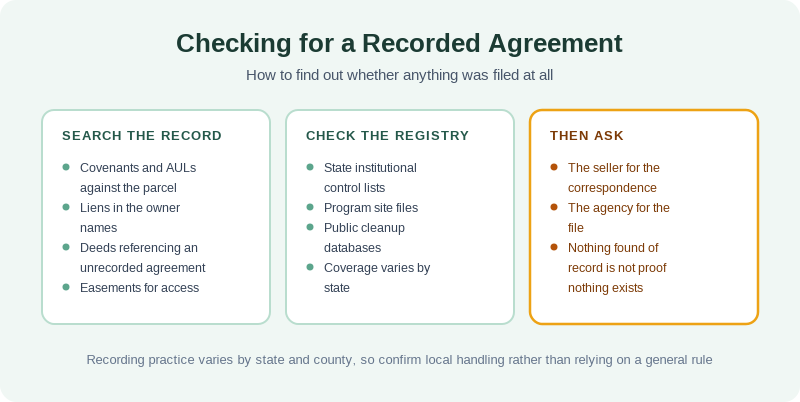
Start with the land record. Covenants and limitations against the parcel, liens indexed in the owner names, access easements, and deeds that reference an agreement without attaching it. That last category is common and useful, because a recital in a deed is often the only public trace that an unrecorded document exists at all.
Then check the state’s institutional control registry, where one exists. Coverage is uneven and a registry is not a land record, but it frequently names sites where something was agreed. Finally, ask the seller for the correspondence and the agency for the file, because a records search cannot reach what nobody filed.
Who the protection actually reaches
The other recurring confusion is about transferability. A comfort letter is written to a named prospective purchaser on facts that party presented, and a subsequent buyer two owners later is not that party. Some prospective purchaser agreements do extend protections to successors and assigns in terms, and some are drafted to run only to the signatory.
That distinction is worth checking in the document itself rather than in the summary somebody gives you. A seller who genuinely has a transferable agreement will usually be glad to show you the clause. A seller who hands you a four year old letter addressed to a different company has given you useful history and nothing more.
Reading the result honestly
A clean search result means no lien, covenant or similar instrument was found of record for the parcel and term searched. It does not mean no agreement exists, no cleanup occurred, and no obligation is outstanding. An unrecorded letter leaves no trace anywhere a searcher can reach, and recording practice varies county by county in any case.
It is also worth separating the regulator’s position from the buyer’s status. A letter describing what an agency intends is not the same thing as the defenses described in innocent landowner and contiguous property defenses, and a no further action letter is narrower still. Whether any of them protects a particular buyer is a legal question for counsel.
The 1980 Environmental Lien & AUL report covers the recorded side of that question. Certified title abstractors review land title and judicial records from 1980 to the present and document every environmental lien, encumbrance, and AUL found, with the recorded instruments attached. It’s $425, delivered by email in 3–5 business days. Order online, or see the FAQ if you want to know how we scope a site with an agreement already in place.
Get an E1527-21 compliant lien & AUL report
Our 1980 Environmental Lien & AUL reports are researched by certified title abstractors, cover judicial records, and are guaranteed accurate. Delivered in 3–5 business days.
or call 877-848-5337