Published
A buyer looks at four hundred acres with a row of empty metal barns, two filled in depressions where lagoons used to be, and a county road frontage that looks like any other piece of farmland. The operation closed in 2009. Whether anything about it reached the county record is a separate question from whether anything about it matters, and the answer to the first one is often no. The pattern is familiar from former agricultural chemical dealer sites, where the activity was intense and the paperwork was thin.
What the operation left behind
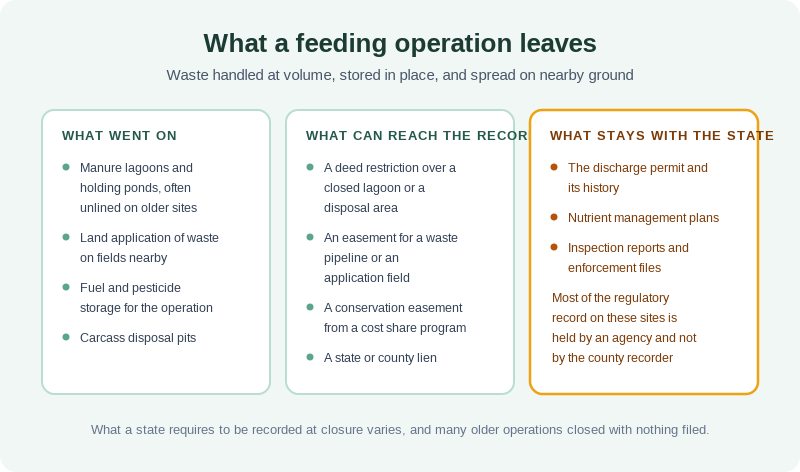
Concentrated feeding produces waste at volume, and the waste has to go somewhere. Manure lagoons and holding ponds, frequently unlined on older sites. Land application on fields nearby, year after year, which moves nitrate and phosphorus into ground the buyer may not be buying. Fuel and pesticide storage for the operation itself. Carcass disposal pits, which older operations handled on site as a matter of course.
What can reach the land record is narrower. A deed restriction over a closed lagoon or a disposal area. An easement for a waste pipeline or for an application field. A conservation easement attached to a cost share program. A state or county lien where enforcement went that far.
Most of the rest stays with an agency. The discharge permit and its history, nutrient management plans, inspection reports and enforcement files all sit in a state office rather than at the recorder, which is why the institutional control registries and the land record have to be checked as two different things.
Who the record names
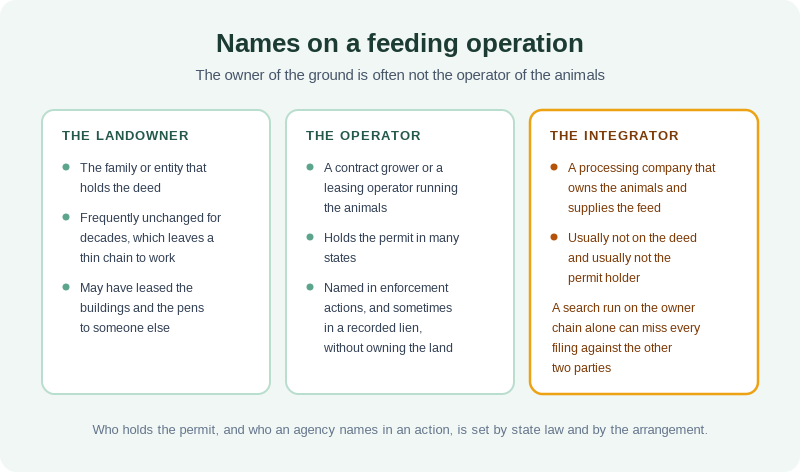
This is the part that catches people. On a great many feeding operations the owner of the ground is not the operator of the animals, and neither one owns the livestock.
The landowner holds the deed, often unchanged for decades, which leaves a thin chain to work with. The operator is a contract grower or a leasing operator who runs the animals and, in many states, holds the permit. The integrator is a processing company that owns the animals and supplies the feed, and is usually on neither the deed nor the permit.
A search run on the owner chain alone can miss every filing against the other two, which is the same failure described in judicial records in an environmental lien search.
Scoping the search
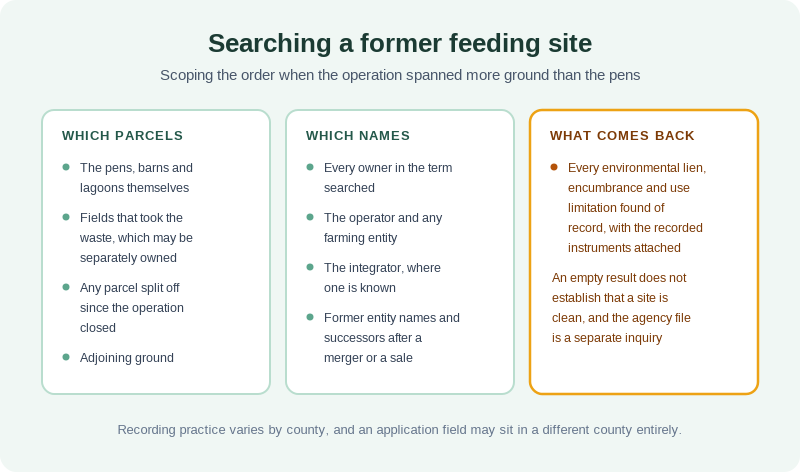
Start with the parcels. The pens, barns and lagoons, the fields that took the waste, which may be separately owned and sometimes sit in another county, any parcel split off since the operation closed, and adjoining ground where a release could have travelled. The adjoining property search matters more here than on a typical industrial site, because land application was designed to spread material across a wide area.
Then the names. Every owner in the term searched, the operator and any farming entity, the integrator where one is known, and former entity names and successors after a merger or a sale.
What comes back is every environmental lien, encumbrance and use limitation found of record, with the recorded instruments attached. An empty result does not establish that a site is clean, and the agency file remains a separate inquiry. Recording practice varies by county.
Where this fits the Phase I
The chain of title and the lien and AUL review are two pieces of all appropriate inquiries, and on a feeding operation they do work the historical sources cannot. Aerial photographs show the pens and the lagoons. They do not show who held the permit, which fields took the waste under a recorded agreement, or whether a closure left a restriction on the deed.
Whether any of it amounts to a recognized environmental condition is the environmental professional’s call under REC, CREC and HREC, not something a records search decides. Our job is to report what was found, clearly enough that the professional can use it.
The takeaway
A closed feeding operation is a site where the activity was heavy, the regulatory file is thick, and the land record may be nearly silent. That gap is the reason to search it properly rather than a reason to skip it. The 1980 Environmental Lien & AUL report is how we do it, and certified title abstractors review land title and judicial records from 1980 to the present and document every environmental lien, encumbrance, and AUL found, with the recorded instruments attached. It’s $425, delivered by email in 3–5 business days. Order online, or read how the search is performed first.
Get an E1527-21 compliant lien & AUL report
Our 1980 Environmental Lien & AUL reports are researched by certified title abstractors, cover judicial records, and are guaranteed accurate. Delivered in 3–5 business days.
or call 877-848-5337