Published
A boatyard is a small industrial site that happens to sit on the water, and the two halves of that sentence create two separate diligence problems. The yard itself carries metals, solvents and petroleum in the ordinary way. The waterward edge carries a boundary nobody can settle from a deed. Both have to be scoped deliberately rather than ordered as a standard product, and the starting frame is the one in how an environmental lien and AUL search is performed.
What went on in the yard
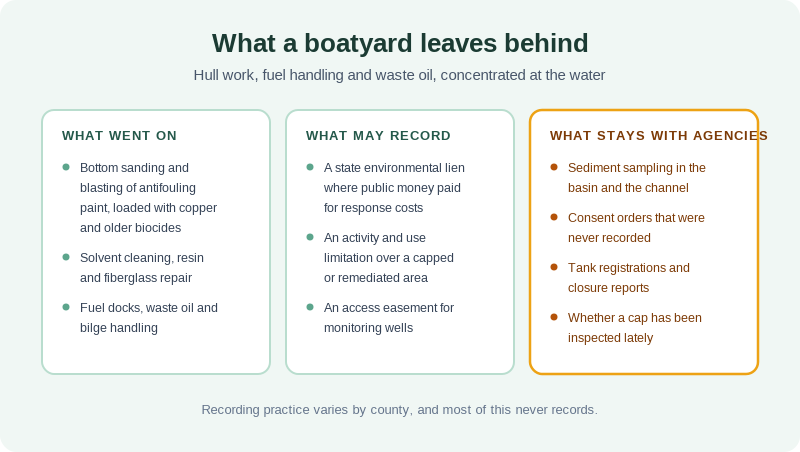
Hull maintenance is the defining activity. Bottom sanding and blasting removes antifouling paint, which through the relevant decades carried copper, and on older vessels tributyltin and lead. The spent material went somewhere, and on a yard built before containment was standard it frequently went onto the ground.
Repair work adds solvents, resins and fiberglass dust, which is the same chlorinated solvent picture that drives former machine shop due diligence in a different setting. Fuel docks, waste oil collection and bilge handling run through everything else, which is where the petroleum comes from.
The result is a site with metals in one place, solvent in another and petroleum in a third, usually across a few acres. That matters for scoping, because a program built around one contaminant says very little about the others, and a records search built around one prior owner has the same weakness.
What can reach the land record
The same three instruments that reach it anywhere. A state environmental lien where public money paid for response costs, the subject of environmental liens explained. An activity and use limitation over a capped or remediated area, which is what what an AUL actually requires sets out in detail. And an access easement for monitoring wells.
What stays outside is most of the substance. Sediment sampling in the basin and the channel, tank registrations and closure reports, consent orders that were never recorded, and whether a cap has been inspected recently are agency and operator material. A parcel can be clean in the county index and still carry a closed disposal area behind the travel lift. That is the boundary of what recording captures, and it is the point data gaps in an environmental lien search keeps returning to.
Where the parcel actually ends
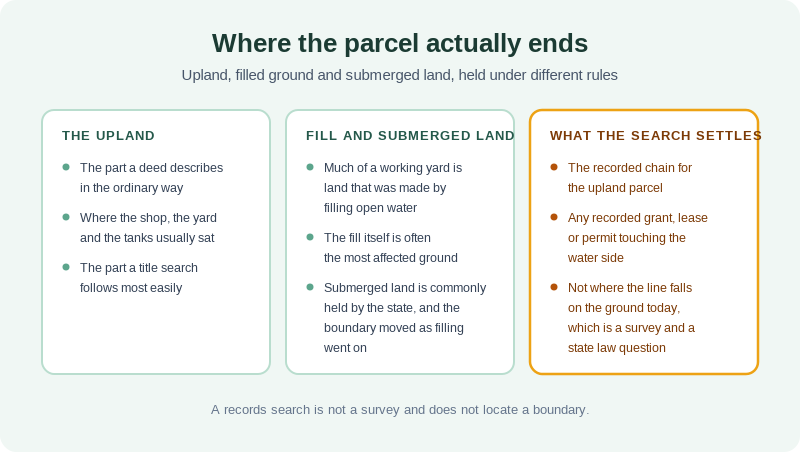
The upland is the easy part. A deed describes it in the ordinary way, a chain follows it without difficulty, and the shop, the yard and the tanks almost always sat on it rather than on anything newer.
Much of a working yard, though, is filled land, made by placing material into open water, and on older sites that fill is frequently the most affected ground present. It is also the least clearly owned. Submerged land is commonly held by the state in trust, and the line between the upland parcel and the state’s interest moved as filling went on.
What a records search settles is the recorded chain for the upland and any recorded grant, lease or permit touching the water side. What it does not settle is where the line falls on the ground today. That is a survey question layered over a state law question, and it is not something a title abstract was ever built to answer.
Scoping the search
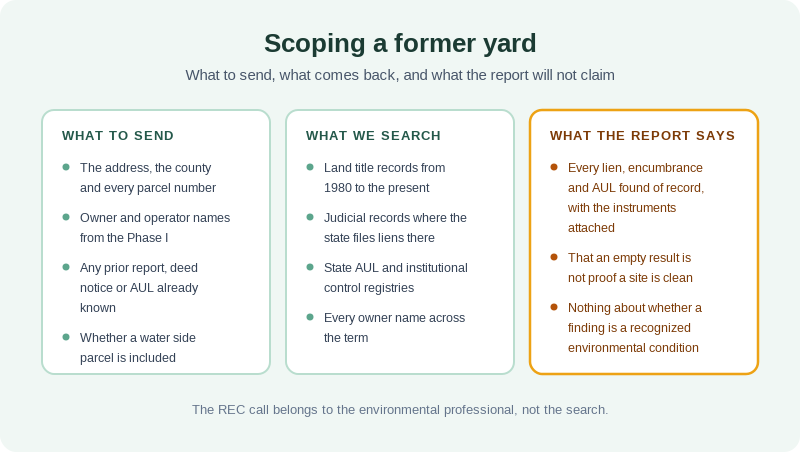
Send the address, the county, every parcel number, the owner and operator names your Phase I turned up, any prior report or deed notice already known, and whether a water side parcel is part of the deal. The last one changes the scope, as the adjoining property environmental lien search does in a different direction.
We search land title records from 1980 to the present, judicial records where the state files liens there, and the state AUL and institutional control registries described in institutional control registries, against every owner name found across the term.
The report documents every lien, encumbrance and AUL found of record, with the recorded instruments attached. It says on its face that an empty result is not proof a site is clean, and it says nothing about whether a finding is a recognized environmental condition. That call belongs to the environmental professional, not to the search.
The 1980 Environmental Lien & AUL report is where this lands. Certified title abstractors review land title and judicial records from 1980 to the present and document every environmental lien, encumbrance, and AUL found, with the recorded instruments attached. It’s $425, delivered by email in 3 to 5 business days. Order online, or see the sample report first.
Get an E1527-21 compliant lien & AUL report
Our 1980 Environmental Lien & AUL reports are researched by certified title abstractors, cover judicial records, and are guaranteed accurate. Delivered in 3–5 business days.
or call 877-848-5337