
Published
A decommissioned municipal wastewater plant is a straightforward industrial parcel with an unusual feature, which is that a large share of what it produced was deliberately taken somewhere else and spread on agricultural ground. That makes this site type two due diligence questions rather than one, and the second question has been reopened in the last few years by attention to per and polyfluoroalkyl substances. The land record carries part of the answer and not the most important part, which is the pattern our note on PFAS restrictions in the land record describes.
What a treatment plant leaves
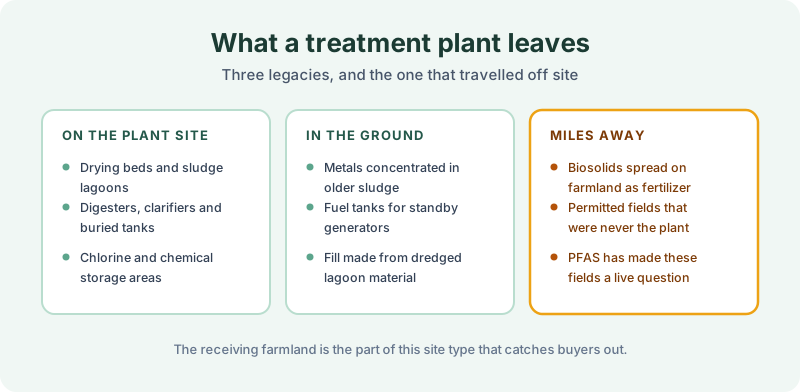
On the plant site the features are conventional. Drying beds and sludge lagoons, digesters, clarifiers and buried tanks, chlorine and chemical storage, and standby generator fuel tanks. None of it is exotic and all of it is the kind of thing a Phase I will identify on a walk, which makes the plant parcel itself the easier half of the assignment.
In the ground the item worth naming is metals. Older sludge concentrated what industry discharged to the sewer, and a plant that served a manufacturing town in the 1960s handled a different material from one serving a bedroom suburb. Lagoon material was frequently dredged and reused as fill on the site itself, so a grading plan drawn from the current surface can sit directly on top of the thing somebody is trying to characterize.
And a great deal of it left. Treated sludge, now called biosolids, has been applied to farmland as a soil amendment for decades under state permits, which means the environmental history of a plant extends to fields that may be twenty miles away and were never owned by the utility. That is the part of this site type that catches buyers out, and not usually the buyers of the plant. A farmer selling ground, or a developer buying it for housing, can be looking at a parcel with a twenty year application history and no idea that the history exists.
What reaches the land record
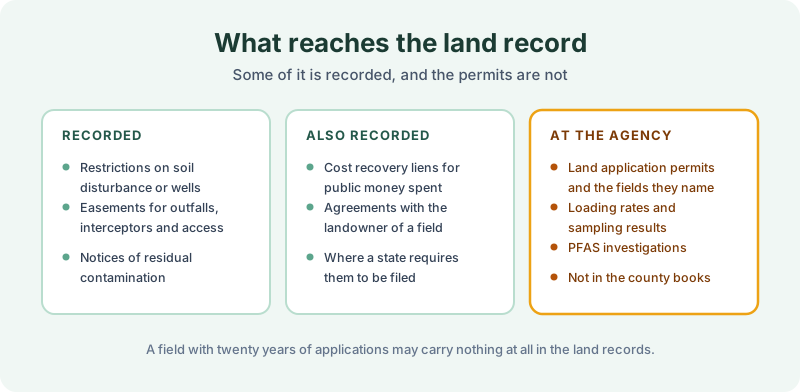
On the plant parcel the usual categories apply. Recorded restrictions limiting soil disturbance or well installation, easements for outfalls, interceptors and access, notices of residual contamination where a state records them, and cost recovery liens securing public money already spent. Those are the instruments covered in our note on environmental covenants and UECA, and the well restrictions overlap with groundwater use restrictions.
On a receiving field there is often nothing at all. Land application runs under a permit held by the generator or the applicator, and in most states the permit does not produce any filing against the farm. Some states require an agreement with the landowner and some require it recorded, so practice varies, and that variation is the whole finding. Where an agreement was recorded it will name the generator and the term, and where none was the land simply carries no public trace of what was spread on it.
The technical material stays with the regulator in both cases. Which fields were permitted, what loading rates applied, and what any sampling showed are agency records rather than county ones, which is why our note on institutional control registries treats the registry as a separate search.
Scoping the search
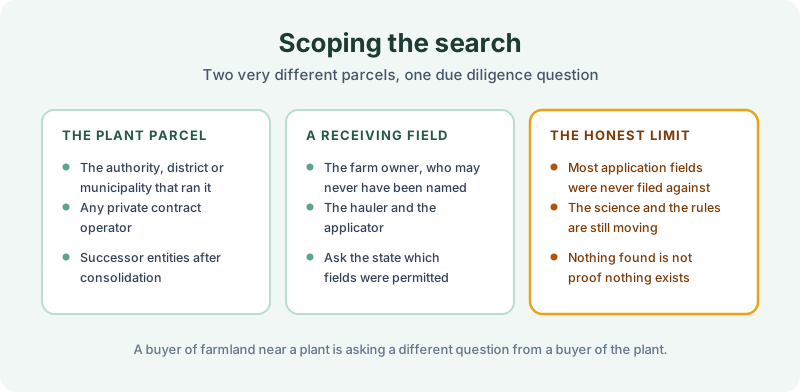
Decide first which parcel is being bought, because the two scopes differ. For the plant, supply the authority, district or municipality that ran it, any private contract operator, and the successor entities left by consolidation. Those names matter because an enforcement action sits in a court index organized by party, which is the dependency in our note on judicial records.
For farmland, the relationship is the one our note on leased property describes from the landowner’s side. The farm owner may never appear in any filing about the material spread on their ground, so the useful request is to the state for the list of permitted fields rather than to the recorder.
Read the result for what it is. A search reports what was recorded and indexed over the term searched, most application fields were never the subject of any filing, and the regulatory position on these compounds is still developing. Nothing found is not proof that nothing exists. The FAQ covers thin and unindexed counties, and a sample report shows the format.
The 1980 Environmental Lien & AUL report is the record half of this work. Certified title abstractors review land title and judicial records from 1980 to the present and document every environmental lien, encumbrance, and AUL found, with the recorded instruments attached. It is $425, delivered by email in 3–5 business days. Order online, or start with our note on how the search is performed if you want the procedure first.
Get an E1527-21 compliant lien & AUL report
Our 1980 Environmental Lien & AUL reports are researched by certified title abstractors, cover judicial records, and are guaranteed accurate. Delivered in 3–5 business days.
or call 877-848-5337