
Published
Most of the recorded environmental controls people encounter came out of a cleanup program, and the program decides what gets filed. Voluntary cleanup programs usually produce a recorded instrument because recording is how the state closes the file. Corrective action under the hazardous waste rules works differently, and the difference is worth understanding before you read a clean index as a clean site.
Where a corrective action control actually lives
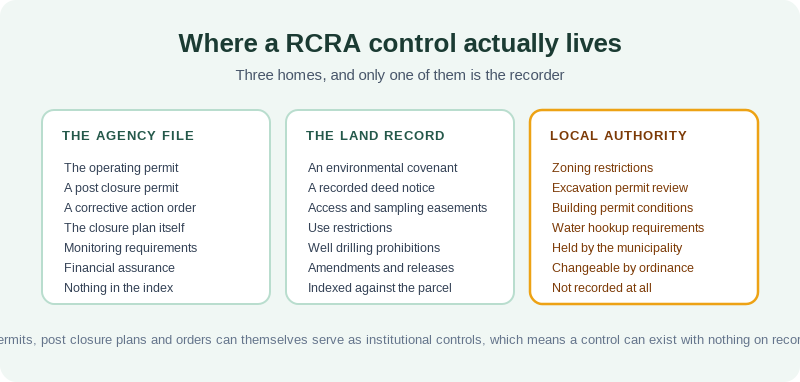
A control imposed under corrective action can sit in three places, and only one of them is the county recorder.
The first is the agency file. EPA has stated that facility permits, including operating, corrective action and post closure permits, along with post closure plans and orders, may themselves serve as institutional controls. A permit condition barring residential use, or requiring a cap to be maintained, is a control whether or not anything is recorded.
The second is the land record, where an environmental covenant, a deed notice, a use restriction or an access and sampling easement is filed against the parcel and indexed like any other instrument.
The third is local authority, where zoning, excavation permit review, building permit conditions or water hookup requirements do the work. Those are municipal and changeable, and nothing about them reaches a grantor and grantee index.
When an obligation becomes a recorded instrument
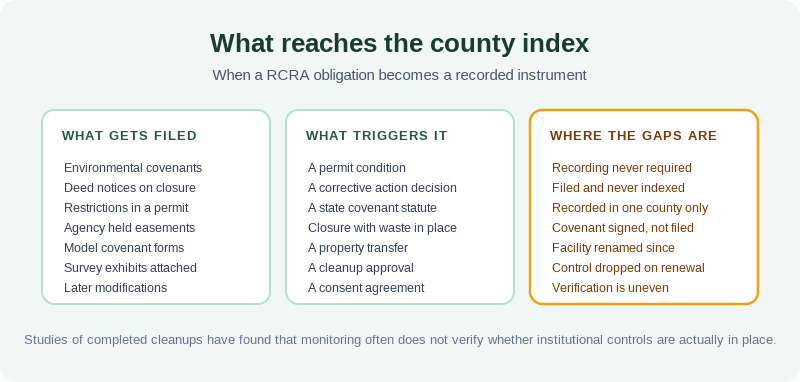
Several things push a corrective action obligation onto the record. A permit condition may require it. A corrective action decision may call for a covenant as a term of approval. A state environmental covenant statute, which most states now have, supplies the form and the recording mechanics, and the uniform act is the common model. Closure with waste left in place is the classic trigger, as is a property transfer, which is frequently when somebody finally records what was agreed years earlier.
EPA and state programs have developed model covenant forms for corrective action sites for exactly that reason, which tells you the recording step was not always happening on its own.
Where the gaps are
Four patterns recur, and each one leaves a regulated parcel looking unburdened in the index.
- Recording was never required. The control is a permit term and nothing more.
- It was filed and never indexed properly. A covenant recorded against one parcel of a multi parcel facility, or under a facility name rather than the owner of record.
- It was signed and never filed. The agreement exists in the agency file with an unrecorded covenant attached.
- It was dropped at a renewal. Permits get modified, and a condition can disappear without anybody recording a release.
Verification is the weak point generally. A federal oversight review of completed cleanups found that monitoring of sites where contamination remains in place often does not include verifying that institutional controls are actually in place. That is a finding about the regulator’s own tracking, and it is a reason to check rather than to assume.
Checking a permitted site before you buy
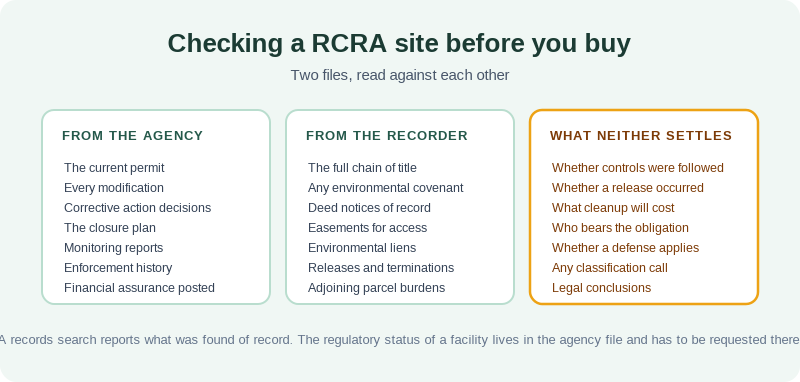
Two files, read against each other. From the agency, request the current permit and every modification, corrective action decisions, the closure plan, monitoring reports, enforcement history and the financial assurance posted. From the recorder, pull the full chain, any environmental covenant or deed notice, access easements, environmental liens, releases and terminations, and the burdens on adjoining parcels where a plume or a monitoring well crosses a line.
Neither file alone answers the question. The index tells you what was recorded and when. The agency file tells you what is required and whether anybody has been checking. Institutional control registries sit between the two and are useful, though their coverage varies by state and they are not a substitute for either source.
What the search establishes
A records search reports what was found of record in the county searched, over the term searched. It is not an inventory of everything affecting the property, an empty result does not prove a parcel is unrestricted, and recording practice varies county by county. On a corrective action site that caveat carries real weight, because a control can be fully in force with nothing in the index at all. Whether a finding is a recognized environmental condition is the environmental professional’s judgment, not something the search decides, and the continuing obligations that follow a purchase are a separate question again.
The 1980 Environmental Lien & AUL report covers the records side. Certified title abstractors review land title and judicial records from 1980 to the present and document every environmental lien, encumbrance, and AUL found, with the recorded instruments attached. It’s $425, delivered by email in 3-5 business days. Order online, see the sample report, or read what an AUL actually requires and how one gets modified.
Get an E1527-21 compliant lien & AUL report
Our 1980 Environmental Lien & AUL reports are researched by certified title abstractors, cover judicial records, and are guaranteed accurate. Delivered in 3–5 business days.
or call 877-848-5337