
Published
A closed aluminum smelter is a large, flat, well served industrial site next to cheap power, which makes it an obvious redevelopment candidate and a demanding one. The process that ran there for fifty years produced a waste stream with its own regulatory history, and the plant usually passed through several owners before it shut. Both facts shape what a records search has to look for. The chemistry differs from a former foundry, and the record problem is a familiar one.
What a smelter leaves behind
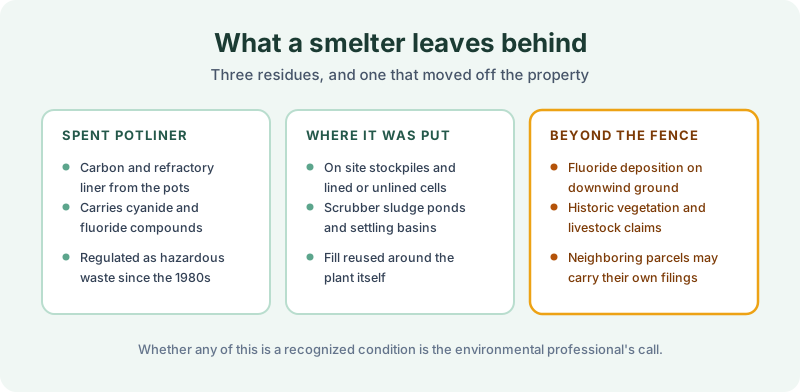
Spent potliner is the item that defines these sites. Reduction cells are lined with carbon and refractory material, the lining degrades over several years, and what comes out carries cyanide and fluoride compounds. It has been regulated as a listed hazardous waste in the United States since the late 1980s, which means that material generated before and after that point was handled very differently.
Where it went is the question that follows. On many sites potliner sat in stockpiles or went into on site cells that may or may not have been lined, alongside scrubber sludge ponds and settling basins. Some of it was reused as fill around the plant, which is how a mapped disposal area becomes an unmapped one.
Fluoride deposition reached past the fence. Emissions from older potlines settled on ground downwind, and historic vegetation and livestock damage claims around smelters are well documented. The practical consequence for due diligence is that neighboring parcels can carry their own filings, which is the situation our note on adjoining property searches addresses. Whether any of this amounts to a recognized environmental condition is a determination for the environmental professional. The record question is narrower.
Filings worth hunting for
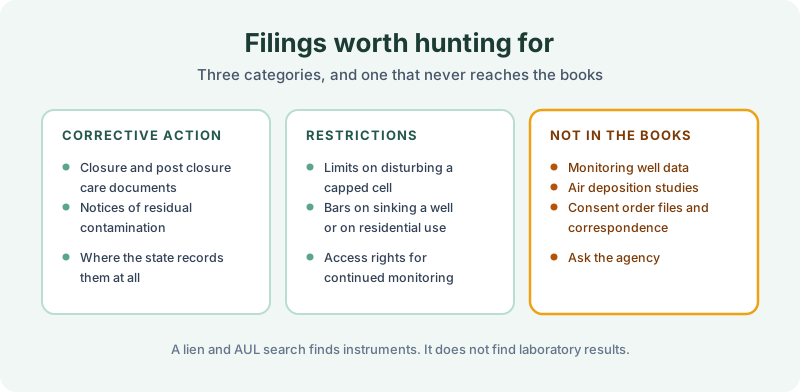
Three categories are worth the effort. Corrective action and closure documents appear where a state records enrollment, a closure certification, or a notice of residual contamination in the county books, and practice is uneven enough that a clean result proves little on its own.
Recorded restrictions are the most consequential, and on a smelter they tend to be specific. A limit on disturbing a capped cell, a prohibition on sinking a well, a bar on residential use over part of the site, and access rights reserved for continued monitoring. Those are the instruments our note on environmental covenants and UECA describes, and the groundwater piece overlaps with groundwater use restrictions.
Cost recovery liens secure public money already spent and may run against the parcel, against an operator, or against both.
What stays with the regulator is the technical material. Monitoring well data, air deposition studies, and consent order correspondence sit in agency files, and several states track institutional controls in a database rather than in the county books, which is why our note on institutional control registries treats them as two separate searches.
Scoping the search
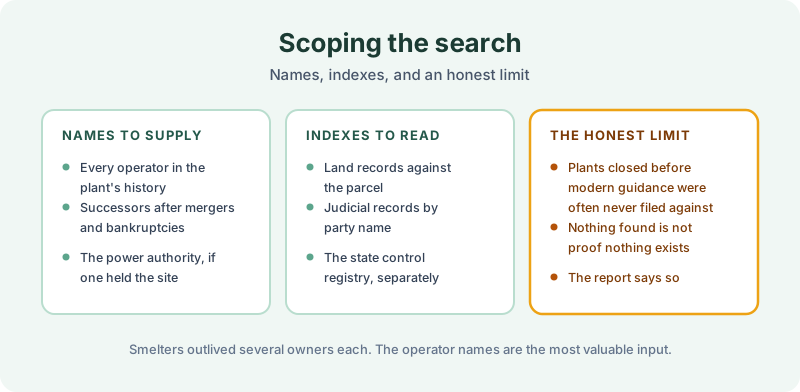
The distinguishing feature of this site type is the ownership history. Primary aluminum capacity changed hands repeatedly through the second half of the twentieth century, and a single plant can have run under four or five corporate names, some of which went through mergers and at least one of which may have gone through bankruptcy. A public power authority sometimes held the land itself.
That matters because an enforcement action or a judgment against a former operator sits in a court index organized by party name rather than by parcel, which is the dependency our note on judicial records sets out. Operator names supplied by the client are the single most valuable input to the search, and on a smelter there are more of them than usual.
Timing is reasonably favorable. Most domestic primary capacity closed from the 1990s onward and the regulatory attention that produced any filings came later still, which puts the relevant activity inside a 1980 forward term. The FAQ covers how thin or unindexed counties are handled, and a sample report shows the format.
Read the result honestly. A search reports what was recorded and indexed over the term searched, and plants that closed before modern guidance were frequently never the subject of any filing, so nothing found is not proof that nothing exists.
The 1980 Environmental Lien & AUL report is the record half of this work. Certified title abstractors review land title and judicial records from 1980 to the present and document every environmental lien, encumbrance, and AUL found, with the recorded instruments attached. It is $425, delivered by email in 3–5 business days. Order online, or start with our note on what an AUL actually requires if a restriction has already surfaced.
Get an E1527-21 compliant lien & AUL report
Our 1980 Environmental Lien & AUL reports are researched by certified title abstractors, cover judicial records, and are guaranteed accurate. Delivered in 3–5 business days.
or call 877-848-5337