Published
The bona fide prospective purchaser defense is the reason most of this due diligence exists. Do the inquiry before you buy, meet the continuing obligations afterward, and you are not liable as an owner for response costs at a contaminated site. That protection is real and it is narrower than its reputation. One thing it does not do is guarantee that the federal government has no claim against the property itself. Our post on BFPP continuing obligations after closing covers the duties. This one covers the lien.
Two federal liens, side by side
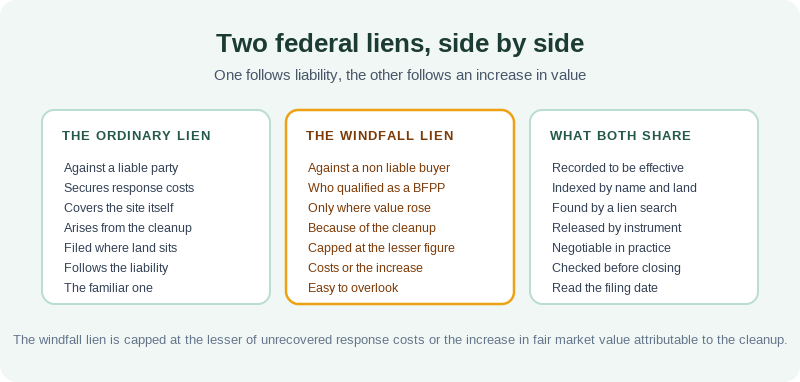
The familiar one is the ordinary Superfund lien, asserted against a liable party to secure unrecovered response costs at the site. Our guide to environmental liens covers how it behaves in practice, and superlien states covers the state equivalents that can outrank a recorded mortgage.
The windfall lien is the quieter one. It is available against a purchaser who does qualify as a bona fide prospective purchaser, and therefore is not liable, where a federal response action increased the fair market value of the property. The amount is capped at the lesser of the unrecovered response costs or that increase in value. The logic is straightforward enough. The buyer did nothing wrong, and the public paid for an improvement the buyer is now holding.
Both liens have to be recorded to do their work, both are indexed and discoverable, and both can be negotiated and released by instrument.
Three conditions, and the one buyers miss
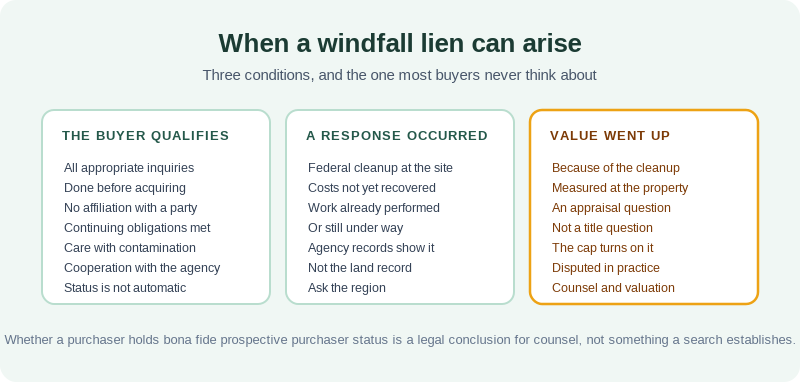
The first condition is that the buyer qualifies. All appropriate inquiries completed before acquiring, no affiliation with a liable party, and the continuing obligations met afterward. Our post on the all appropriate inquiries rule sets out what the inquiry requires, and innocent landowner and contiguous property defenses covers the neighboring protections built on the same foundation. Status is not automatic and it is not something a report confers.
The second is that a federal response occurred with costs not yet recovered. That is an agency fact rather than a land record fact.
The third is the one buyers do not think about, which is that the property increased in value because of the cleanup. It is an appraisal question rather than a title question, it is frequently disputed, and the cap turns entirely on it.
When the lien is already on the record
There is a second version of this problem that is easier to handle and more common than the first. A buyer acquires property that already carries a filed federal lien, whether an ordinary one against the former owner or a windfall lien from an earlier transfer. In that case the question is not whether something might be asserted later. It is sitting in the index with a date and a reference on it.
The practical route is usually to resolve it at or near closing rather than to take title subject to it. The government has a published mechanism for releasing and waiving a windfall lien in exchange for payment and an agreement to comply with the property requirements, and regional staff rather than headquarters generally hold the authority to sign. None of that moves quickly, which is the argument for finding the filing during diligence instead of during escrow.
What matters for the search is that an existing filing is discoverable in a way a future one is not. Read its date, its reference to the site, and whether anything releasing it was recorded afterward, exactly as you would with any other lien.
Checking before you buy
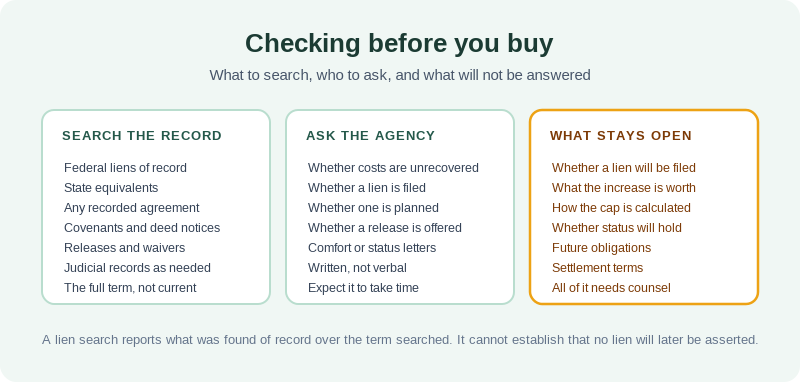
A records search covers the recorded side, meaning federal liens of record, state equivalents, any recorded agreement or waiver, covenants and deed notices, releases, and the judicial records that sit alongside them. The term searched matters here, because a filing from an earlier decade falls outside a current owner search.
Running alongside it is an inquiry to the agency about whether costs remain unrecovered, whether a lien has been filed, whether one is contemplated, and whether a release or waiver is available. Ask in writing and expect it to take time. Comfort letters and prospective purchaser agreements are the instruments that often come out of that conversation.
What stays open is whether a lien will be asserted at all, what any increase in value is worth, and how the cap would be calculated. Those are negotiation and valuation questions for counsel. Our note on what to do when a lien is found covers the practical sequence once something turns up. A search reports what was found of record over the term searched, and it cannot establish that nothing will later be filed.
The 1980 Environmental Lien & AUL report is where the recorded half of this starts. Certified title abstractors review land title and judicial records from 1980 to the present and document every environmental lien, encumbrance, and AUL found, with the recorded instruments attached. It’s $425, delivered by email in 3-5 business days. Order online, see a sample report, or check the FAQ for what the term covers.
Get an E1527-21 compliant lien & AUL report
Our 1980 Environmental Lien & AUL reports are researched by certified title abstractors, cover judicial records, and are guaranteed accurate. Delivered in 3–5 business days.
or call 877-848-5337