Published
Asbestos products manufacturing ran at scale in the United States for most of the twentieth century, turning out board, pipe insulation, shingles, brake linings, and floor tile from plants that were often the largest employer in a small city. The buildings are mostly gone now, and the parcels are attractive, being flat, served by rail, and close to town. The due diligence question resembles the one on a former wood treating site, with one structural difference that runs through the whole file. The party that operated the plant frequently no longer exists.
What the plant left on the parcel
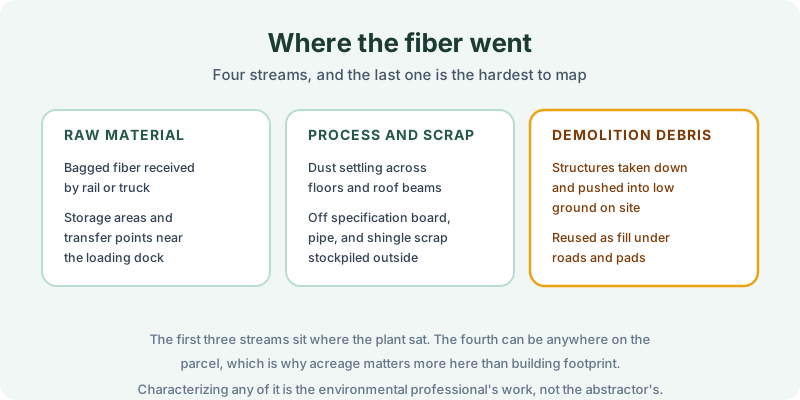
Raw material handling concentrated at the receiving end. Fiber arrived bagged by rail or truck, and the storage and transfer areas near the dock saw the heaviest loading over the plant’s life.
Process dust did not stay in the process. It settled across floors, ledges, and roof structure throughout the building, which matters less for the soil question than for what happened when the building came down.
Off specification product and scrap was routinely stockpiled outside. Broken board, cut ends, and rejected batches went to a corner of the yard, and those corners are frequently outside the footprint anyone thinks of as the plant.
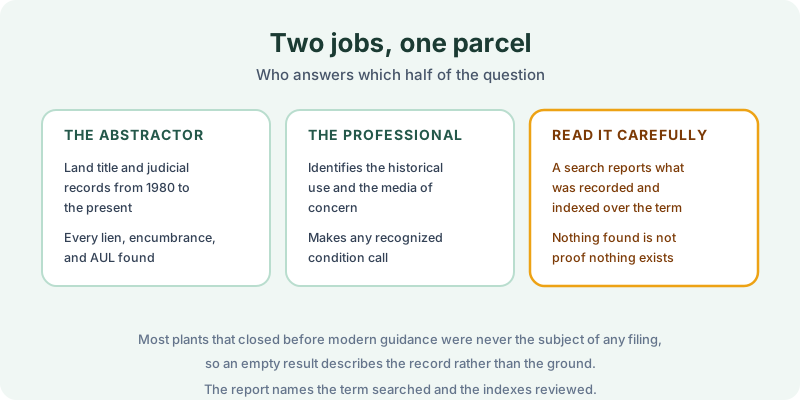
Demolition debris is the stream that converts a mapped problem into an unmapped one. When a plant was taken down, the debris was often pushed into low ground on site or reused as fill under a road or a pad rather than hauled away. That is why acreage matters more than building footprint on these parcels, and why a plant that occupied two acres of a forty acre tract is not a two acre question. Whether any of this constitutes a recognized environmental condition is the environmental professional’s determination, not the abstractor’s. The record contribution is narrower, which is what anyone filed about it.
What the record may carry
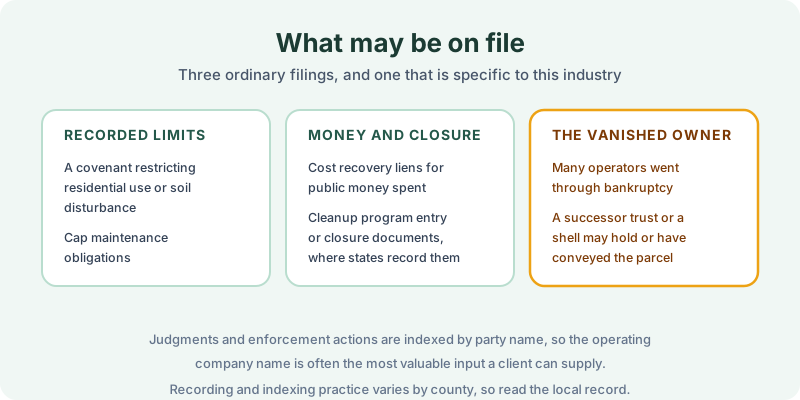
Three filings are worth hunting for. Recorded covenants are the most consequential, because the usual condition on these sites is not a prohibition on all use but a limit on residential development, excavation, or disturbing a soil cap over consolidated debris. Those instruments are the subject of our note on environmental covenants and UECA. Cost recovery liens secure public money already spent and may run against the parcel, the operator, or both, and in a handful of states such a lien can outrank an existing mortgage. Cleanup program filings appear where a state records enrollment or closure in the land records, which our note on voluntary cleanup programs shows is uneven practice.
The fourth item is specific to this industry. A great many asbestos manufacturers went through bankruptcy, frequently resolving into a successor trust, and the entity that held the real estate at closure may be a shell, a trust, or a name that appears nowhere in the operating history. Enforcement actions and judgments against those entities sit in court indexes organized by party name, which is the dependency described in our note on judicial records. The operating company name supplied by the client is often the single most valuable input to the search. Timing helps here as well. Domestic production of most asbestos products wound down through the 1970s and 1980s, so the closure, the demolition, and any resulting filing frequently land inside the 1980 forward window a lien and AUL search covers, which is the reasoning behind the 1980 date.
Scoping the search
Two wrinkles show up on these parcels. The first is subdivision. Large industrial acreage is commonly cut into smaller lots or an industrial park, so a covenant recorded against the original tract may sit under a legal description that no longer matches the lot being sold, the problem examined in our note on an AUL when a parcel is subdivided. The second is registry coverage, because several states track institutional controls in a database rather than only in the county books, which our note on institutional control registries treats as two separate searches.
Read the result for what it is. A search reports what was recorded and indexed over the term searched, and most plants that closed before modern guidance were never the subject of any filing, so nothing found is not proof that nothing exists. The FAQ covers how we handle thin or unindexed counties, and a sample report shows the format the findings arrive in.
The 1980 Environmental Lien & AUL report is the record half of this work. Certified title abstractors review land title and judicial records from 1980 to the present and document every environmental lien, encumbrance, and AUL found, with the recorded instruments attached. It is $425, delivered by email in 3–5 business days. Order online, or start with our note on what an AUL actually requires if a restriction has already turned up.
Get an E1527-21 compliant lien & AUL report
Our 1980 Environmental Lien & AUL reports are researched by certified title abstractors, cover judicial records, and are guaranteed accurate. Delivered in 3–5 business days.
or call 877-848-5337