
Published
An industrial laundry is not a dry cleaner and it is not a laundromat, and reading it as either one understates it. These plants washed uniforms, shop towels, mats and linens at volume for manufacturers, garages and restaurants, and the solvent that matters arrived soaked into the work rather than in a drum on the dock. That single fact makes the site behave differently from the dry cleaner next to it in your archetype list.
What an industrial laundry leaves
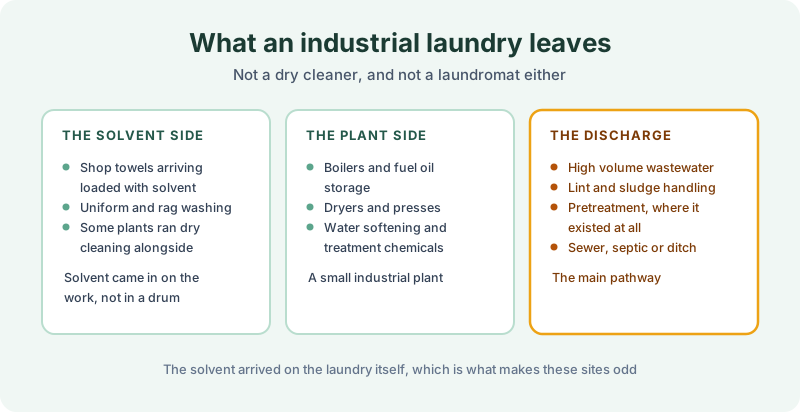
The solvent side is the unusual part. A plant serving machine shops and garages took in towels and uniforms carrying degreasers, cutting oils and chlorinated solvents, and most of that came off in the wash. Some plants also ran a dry cleaning line alongside the water wash, which puts the chemistry of a metal plating shop customer and a dry cleaner on the same parcel.
The plant side is ordinary light industry. Boilers and fuel oil storage, dryers and presses, and water treatment chemicals for softening and conditioning. Older plants burned heavier fuel and stored it on site, which is a tank question in its own right.
The lint and sludge are worth a line as well. A plant handling shop towels generated a filter cake and a lint waste stream that carried whatever the towels carried, and before the waste rules tightened a good deal of it went into a dumpster or onto the back of the lot. Where that happened it is a soil question on the parcel rather than a discharge question downstream.
The discharge is the main pathway. These are high volume water users, and the effluent carried solvent, oil, lint and sludge. Where the plant was on a municipal sewer under a pretreatment agreement, the sewer authority is likely to hold a long and detailed file. Where it was on a septic system or discharged to a ditch, the material went into the ground on or near the parcel.
Where the filings land
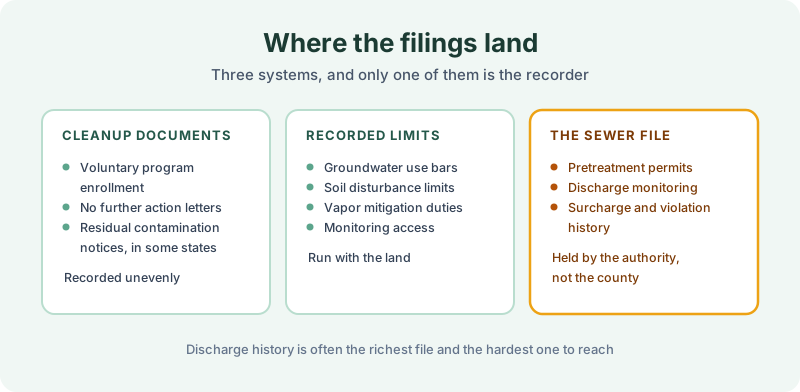
Cleanup documents turn up where the plant was enrolled in a state program. Enrollment records, no further action letters and residual contamination notices are recorded in some states and simply filed in others, and what a no further action letter means is worth reading before treating one as a clearance.
Recorded limits are the instruments that bind a buyer. A bar on sinking a well, a limit on disturbing soil below a depth, an obligation to maintain vapor mitigation, and access reserved for monitoring all run with the land when they were recorded, the mechanism in environmental covenants and UECA. The well restriction overlaps directly with groundwater use restrictions.
The sewer file sits outside the land record entirely. Pretreatment permits, discharge monitoring reports and any violation or surcharge history are held by the authority, and a county search will not reach them. Several states also keep institutional controls in a database rather than the county books, which institutional control registries covers.
Scoping the search
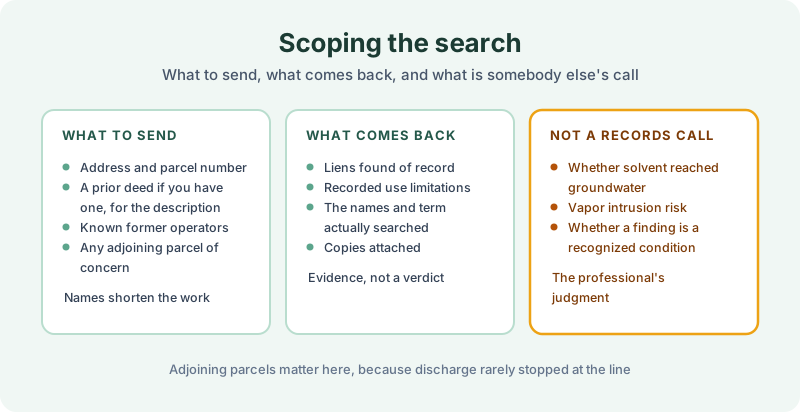
Send the address, the parcel number and a prior deed if you have one, since the description is what the recorder indexes against. Name any former operators you already know, because these plants changed hands and changed names, and a chain that runs through three corporate identities takes longer to reconstruct than to search.
Flag adjoining parcels worth covering. Discharge and drainage did not stop at a property line, and the questions in adjoining property searches apply here more than on a self contained site.
Term length is the other scoping decision. Many of these plants ran from the 1950s through the 1990s, so a window opening in 1980 catches the later operating years and the closure, while the earlier and frequently dirtier period sits above it. Whether that matters depends on what the file is being used for, and it is a question worth settling before the order rather than after the report.
What comes back is the liens and recorded use limitations found of record against the parcel and the names searched, with the term stated and copies attached. Whether solvent reached groundwater, whether vapor is a live concern indoors, and whether any finding is a recognized environmental condition are judgments for the environmental professional, and vapor intrusion and recorded use restrictions explains where the boundary falls.
The takeaway
A records search reports what was found of record in the indexes reviewed over the term searched, and a clean result is a statement about the record rather than about the ground. The 1980 Environmental Lien & AUL report is the product that covers this. Certified title abstractors review land title and judicial records from 1980 to the present and document every environmental lien, encumbrance, and AUL found, with the recorded instruments attached. It’s $425, delivered by email in 3 to 5 business days. Order online, or read the chain of title behind a Phase I if you are still deciding how far back to go.
Get an E1527-21 compliant lien & AUL report
Our 1980 Environmental Lien & AUL reports are researched by certified title abstractors, cover judicial records, and are guaranteed accurate. Delivered in 3–5 business days.
or call 877-848-5337