
Published
A former bus depot is three industrial uses on one parcel, which is why it reads as heavier than its acreage suggests. It fueled, it repaired, and it washed, every day, for as long as the operator held it. The fueling half behaves like the former gas station your file already knows how to handle. The repair half behaves like a machine shop. The third half, the drainage, is the one that moves material off the property.
What a transit garage leaves
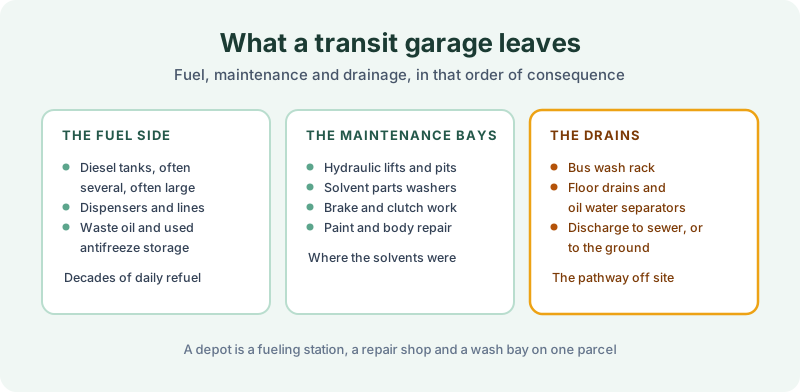
The fuel side is the largest in volume. Diesel storage at a depot is rarely one small tank, and dispensers, piping runs and waste oil storage all sit alongside it. Where the tanks were underground, the state tank program is likely to hold a file whether or not anything was ever recorded locally.
The maintenance bays carry the solvent history. Lifts and service pits, parts washers, brake and clutch work, and on larger properties a paint and body shop. The chemicals in that list changed several times over the decades a depot operated, and the older the operation the less documentation exists about what was in use when.
The drains are the pathway. A bus wash rack moves a great deal of water, and the floor drains in a maintenance bay collect whatever lands on the floor. Where that drainage ran to an oil water separator and then to a sewer, the sewer authority may hold a long file. Where it ran to a dry well or a ditch, the material went into the ground. Characterizing any of this is the environmental professional’s work rather than the abstractor’s, and our note on REC, CREC and HREC classification is where that line sits.
Where the filings land
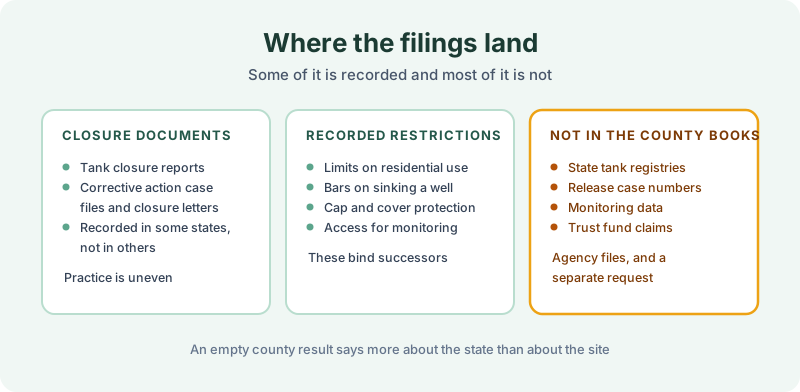
Closure documents appear in the county books in some states and never in others. A tank closure report, a corrective action case file or a closure letter may be recorded, enrolled in a database, or simply filed at the agency, and the practice is uneven enough that the absence of a county filing says more about the state than about the site.
Recorded restrictions are the category that binds a buyer. Limits on residential use, a bar on sinking a well, an obligation to maintain a cap, and access reserved for monitoring all run with the land where they were recorded as instruments, the mechanism set out in environmental covenants and UECA. The well restriction in particular overlaps with groundwater use restrictions.
What stays with the regulator is most of the technical record. State tank registries, release case numbers, monitoring data and trust fund claims are agency material, and several states track institutional controls in a registry rather than in the county books, as institutional control registries explains.
A closure letter is worth treating carefully on a site of this kind. Closure is granted against the use and the standard that applied at the time, and a depot closed to a commercial standard in 1998 was not evaluated against a residential one. Our note on what a no further action letter means sets out why the letter is a record of a decision rather than a statement about the condition today.
What the search returns
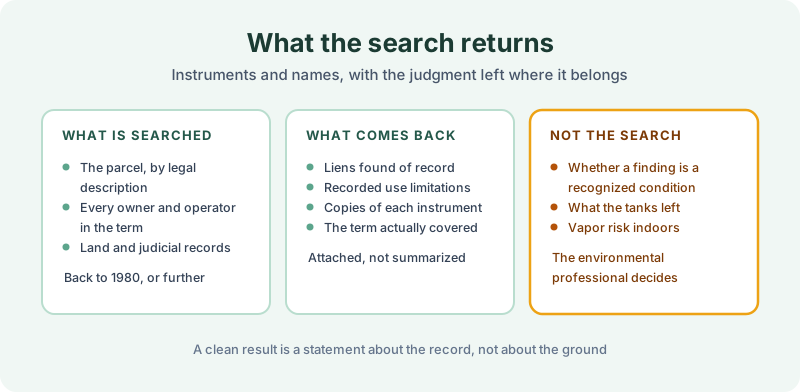
The search runs the parcel by its legal description and every owner and operator in the term, through land records and judicial records, and returns the liens and recorded use limitations it finds with copies of each instrument attached. Municipal ownership is common on these sites and is worth flagging at intake, because a transit authority, a city and a leasing entity may all appear in the chain under different names.
Two site features are worth naming in the order. Depots frequently sit beside rail, which brings the questions in our note on adjoining property searches into play. And many of them have already been redeveloped, so the current parcel may be a fragment of the original operation, which changes the description the search has to run.
The redevelopment point deserves a sentence more. Where a depot occupied four acres and the parcel now in front of you is one of them, the restrictions recorded at closure may describe a remediation footprint rather than a property line, and whether your acre sits inside that footprint is read off the instrument rather than assumed. Sending a prior deed at intake is the quickest way to get the description right.
The takeaway
A records search reports what was found of record, and an empty result is a statement about the index rather than about the ground. Vapor intrusion, tank integrity and the significance of any finding are not land records questions, and vapor intrusion and recorded use restrictions explains where that boundary falls. The 1980 Environmental Lien & AUL report is where this lands in practice. Certified title abstractors review land title and judicial records from 1980 to the present and document every environmental lien, encumbrance, and AUL found, with the recorded instruments attached. It’s $425, delivered by email in 3 to 5 business days. Order online, or start with the chain of title behind a Phase I if you are still scoping the work.
Get an E1527-21 compliant lien & AUL report
Our 1980 Environmental Lien & AUL reports are researched by certified title abstractors, cover judicial records, and are guaranteed accurate. Delivered in 3–5 business days.
or call 877-848-5337